


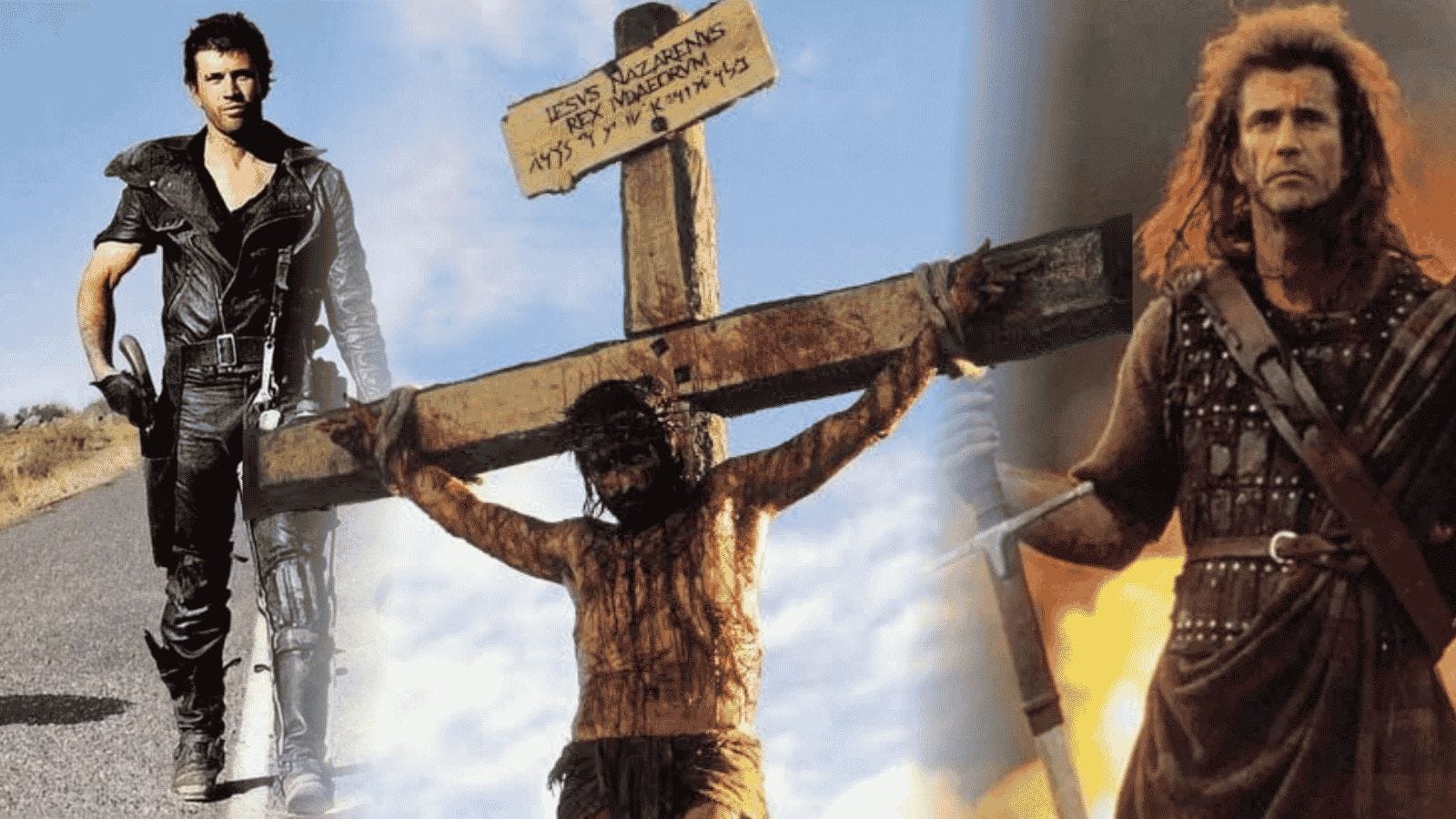
We wouldn’t be a Catholic film blog if we didn’t have a deep love and appreciation for the madman known as Mel Gibson. He is a man of many contradictions: the popcorn-flick action star who made one of the most deeply meditative works of sacred art in film; the publicly devout traditional Catholic who is also a divorced womanizer and sedevacantist; the director of explicitly Christian films who received mainstream acclaim and Academy Award success. He has achieved incredible success as both an actor and director, runs his own movie production house, and is a philanthropist and regular patron of Catholic arts; he has also been in (and recently directed) some really bad films, been exiled from Hollywood, and floated some questionable ideas in both politics and theology. He’s a fascinating man and has acted in and directed some fascinating films, and his career is well-worth a look by any Catholic film-lover.
Mel Colmcille Gerard Gibson was born in New York in 1956. His family moved to Australia when he was 12 years old, and he got his start in acting on the Australian stage in productions of Shakespeare, including Romeo and Juliet and A Midsummer Night’s Dream. He was more interested in the movies than the theater, however, and took various roles in low-budget Australian movies. One of these would launch him to stardom: 1979’s Mad Max, directed by George Miller. Gibson plays the protagonist Max Rockatansky, a police officer and family man turned vigilante killer by brutal events in an apocalyptic future. Mel would return to this role two more times, cementing his status as a cinematic icon very early in his career.
Max Rockatansky, however, would not lock Gibson into pulp action star typecasting. He would take several dramatic roles in the 1980s, including a couple for Australian director Peter Weir1 and an excellent turn as mutineer Fletcher Christian across from Anthony Hopkins in 1984’s The Bounty. Although our perception of him is as an action star, he would continue to take interesting and varied roles throughout his career, refusing to be typecast and bringing his strong dramatic and comedic skills even to his action roles. He would return to his Shakespearean roots with 1990’s messy but compelling Hamlet; he starred alongside a young Elijah Wood in the weird little sci-fi romance Forever Young; and he turned in a hilarious performance as the titular character in the underrated comedy-western Maverick. He even took voice acting roles in a couple of high-profile animated films, Pocohontas and Chicken Run. Mel’s career in the 1980s and 1990s was interesting and varied, demonstrating his versatility as an actor and eclectic taste in film.
Of course, in the late 80s and through the 90s Gibson would also become one of America’s biggest action stars and one of its most exciting new directors. In 1987 he took his second iconic action role, Martin Riggs in Richard Donner’s Lethal Weapon. The four Lethal Weapon movies comprise one of the best 90s action franchises, rivaled only by the first three Die Hard movies. They are fast-paced, incredibly well-directed, smart, funny, thrilling, and surprisingly wholesome. They also do not shy away from some of the darker corners of 80s and 90s America, examining high crime rates and political themes that some other films were too scared to touch. The central friendship between Riggs and Murtagh (Danny Glover) keeps the whole series grounded, however, and the light always triumphs over the darkness, making every return to Lethal Weapon seem like a breath of fresh air compared to today’s morally grey antiheroes and brutality for shock value rather than good storytelling. Gibson was firmly established as an action star after Lethal Weapon, taking many action and thriller roles in the 90s such as Air America, Ransom, Conspiracy Theory, and Payback. These films are of varying quality, but Gibson always gives it his all with his trademark mix of intensity and humor.
As much success as he saw in front of the camera, Gibson was also becoming interested in doing more work behind it as well. His directorial debut, 1993’s The Man Without a Face, is a drama that sees him play Justin McLeod, a man disfigured in a car accident who befriends and educates young Chuck Norstadt — to the suspicion of the rest of town. It’s a compelling drama, definitely showing Gibson’s storytelling instincts and eye for direction. He would jump straight from this modest drama to a full-blown historical epic two years later with Braveheart, to great critical acclaim. Braveheart is an immense cinematic achievement, following William Wallace in his lifelong struggle to free Scotland from English tyranny. It deserves its own dedicated analysis, but one of the interesting facets of it for our readers is that Gibson seeded the film with several Catholic elements that leap off the screen in light of his later films. Though not explicitly Catholic, it is a shining example of Catholic filmmaking by weaving imagery, themes, and quality craftsmanship to make a film which teaches without preaching, and is an absolute joy to watch as well. Braveheart won 5 Academy Awards, including Best Picture and Best Director for Gibson, and put him on the map as an acclaimed filmmaker as well as a popular actor.
The early 2000s were good for Gibson as well, with classics such as The Patriot, We Were Soldiers, and Signs (#71) all being well-received. At this point, Gibson took his biggest creative swing of his career: 2004’s The Passion of the Christ (#53). As our writer Charles Scott said in his review for The List:
The Passion of the Christ serves as the truest form of an Icon within the 21st century, and while not the prettiest or easiest film to watch (arguably one of the most difficult films to watch), it stands as the most powerful, spiritual, and moving piece of religious cinema ever crafted.
The Passion is Mel’s masterpiece, the sort of film that only he could have the audacity, resources, and clout to make. It is arguably the best piece of Catholic cinema of all time; so of course it was not particularly well-received in mainstream Hollywood. Although considered a classic in most Christian circles, it is widely considered “controversial” among secular critics. From the moment he released The Passion of the Christ, it seemed like the Hollywood establishment, like the Pharisees in the Gospel, took counsel how to put his career to death.
They wouldn’t immediately succeed, as Gibson released Apocalypto in 2006, another historical epic set in Mesoamerica and (like The Passion) entirely in the languages of the historical peoples. Apocalypto is brutal, haunting, and ruthlessly compelling, tying together many of the themes of Mel’s body of work into one insanely ambitious package. Although generally well-regarded, it would be Mel’s last film for a decade as events from his personal life would give Hollywood its pretense to banish him from stardom.
On July 28, 2006, Mel Gibson was arrested for drunk driving and had an altercation with the police which would be recorded and leaked to the press in the coming weeks. He made some remarks about the Jewish race which served to confirm secular and Jewish suspicions about the portrayal of the Jews in The Passion of the Christ.2 Gibson took some time away to recover from alcoholism, went through a divorce, and faced domestic assault allegations from the woman he shacked up with, and throughout this time Hollywood seemed to be completely done with him for all intents and purposes. Documentaries were made to mock him, he was the butt of jokes on shows such as South Park, and it would take a miracle for him to resurrect his career.
However, Gibson was not totally friendless. It would be partially through the influence of his friend Robert Downey Jr., who had gone through his own redemption arc and was on top of the world as the star of the Marvel Cinematic Universe, that Gibson would be given another chance. He starred in a few low-profile films starting in 2012, before returning to blockbusters in Sylvester Stallone’s action franchise The Expendables 3 in 2014. He would complete his redemption arc with another directorial project, Hacksaw Ridge, in 2016. Hacksaw Ridge is another masterpiece about a Christian army medic who refuses to take up arms but would save dozens of fellow soldiers in the Battle of Okinawa. Mel remained unapologetically Christian through it all, not toning down his filmmaking but telling such a compelling story that it broke through his blacklist and earned him another two Oscars. Gibson seemed like he was fully back, and rumblings even started that he was working on a followup to The Passion of the Christ.
However, Gibson’s career since Hacksaw Ridge has been mostly marked by low-budget action schlock, fun pulpy adventures for those (like me) who enjoy them but nothing approaching the genius of Braveheart or Hacksaw Ridge. He’s also become something of a patron of Catholic cinema, acting in 2022’s Father Stu alongside Mark Wahlberg and in David Henrie’s 2024 directorial debut Monster Summer. He’s joined the John Wick franchise, rumored that he will be returning to Lethal Weapon (though with Danny Glover’s health in decline this seems unlikely), and yes, has finally made The Resurrection of the Christ. This long-awaited project wrapped production in June of 2026 and is set to be released in two parts next year. We Catholics await this project with bated breath, hoping for a masterpiece but knowing that (according to the rumors) this could be Gibson’s most ambitious, crazy, personal project yet.
Mel Gibson holds a special place in my heart, his films touching on my favorite genres while providing a Catholic perspective that stands out in amoral Hollywood. Though his sedevacantist perspective leaves me unable to fully hold him up as a Catholic example, his artistic instincts are unparalleled and have given us some of the best Catholic films of all time and his traditionalism ensures that the best of the past 2000 years of Catholic art, thought, and spirituality inform his work. I have great hope that his Resurrection project will at least approach the spiritual and artistic heights of The Passion and appreciate his support of Catholic filmmaking in the 2020s. Whatever else can be said about Mel Gibson, he’s certainly interesting and takes his faith incredibly seriously, and for this reason he deserves the crown of premier Catholic auteur of the past 30 years.
Mad Mel, I salute you.
Who would later direct two movies that landed on our list of 100 Movies Every Catholic Should See: Master and Commander: The Far Side of the World (#30) and The Truman Show (#42).
I, along with most Catholics, would argue that there is no antisemitism present in the film, but that issue has been beaten to death and this is neither the time or place to revive it.
I suspect a lot of Mel’s recent movie roles were to help him finance projects like “The Resurrection of the Christ.” I’d imagine not a lot of people wanted to contribute to it (just like the first movie), so he’s taking a page from Orson Welles’ book and raising money himself anywhere he can.