


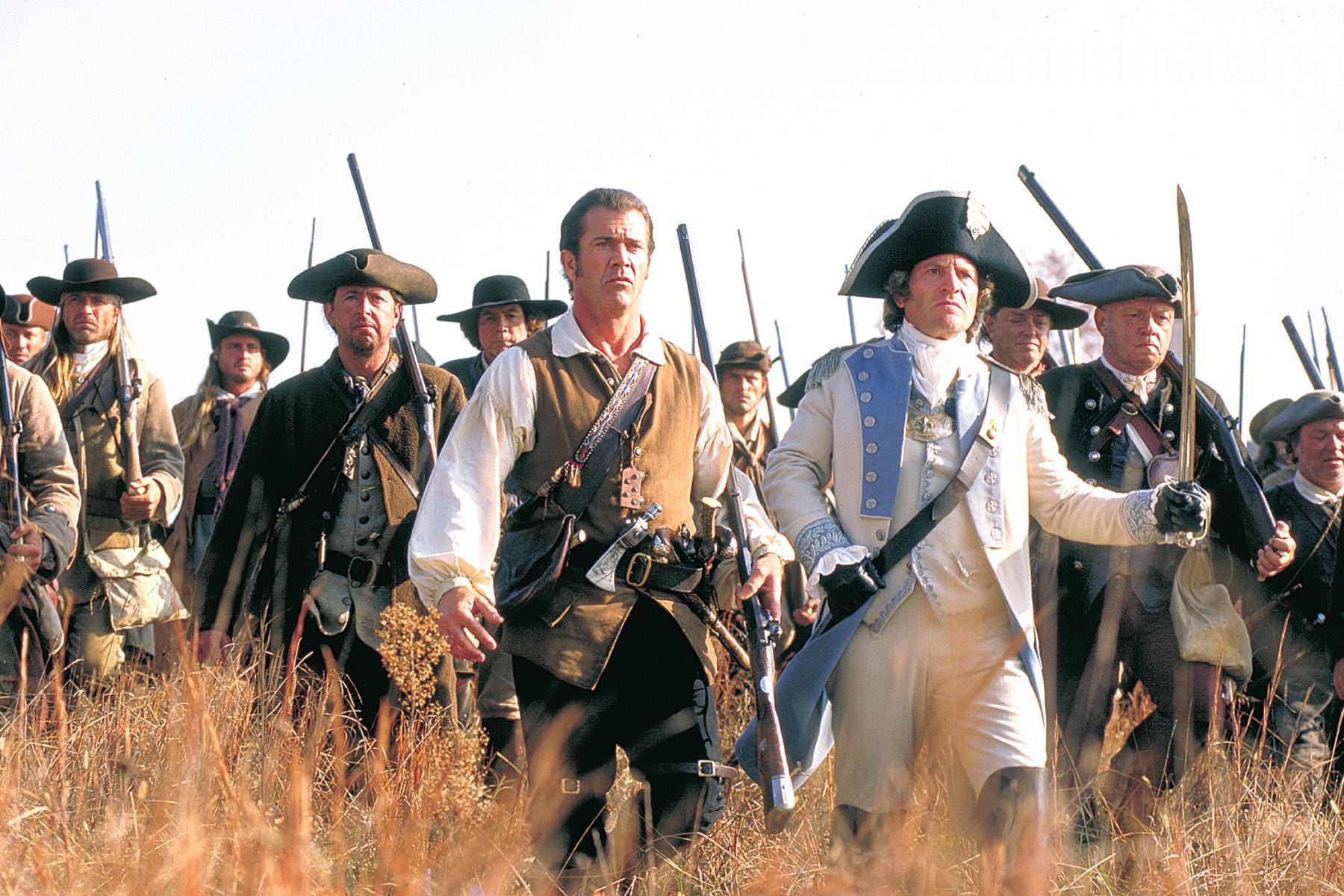
There is something poetic in the way Mel Gibson leads a ragtag group of rebels against the English monarchy massacring them in brutal ways and leading his forces towards eventual victory. This film, however, is not Braveheart. These are American rebels fighting against the British during the American War for Independence in Roland Emmerich’s The Patriot!
There are several parallels between the two films: Mel Gibson’s character, Benjamin Martin, reluctantly joins the rebel cause only after a family member dies, the British brutally murder innocent non-combatants, the rebels operate out of a swamp, a foreign ally aids Gibson’s troops and many others.
But, where Braveheart is wondrously epic, The Patriot tells a more down-to-earth story instead of being grandiose. While all of these parallels between the two films exist, the main themes of the stories are totally different. As previously discussed, in Braveheart, the theme of the film concerns leadership; whereas, The Patriot focuses on legacy and the promise of the New World.
The first forty-five minutes of this film are a masterclass in storytelling. The first forty-five minutes are well condensed allowing the film to breathe and explore its themes over the remaining two hours of run time. Every major character, their relationships, the main conflicts between characters, the setting, and the film’s main theme are all introduced within its opening forty-five. The compact opening of The Patriot empowers the film to develop and examine its theme of legacy through four essential characters: Benjamin Martin, Gabriel Martin (Heath Ledger), Lord Cornwallis (Tom WIlkinson), and the dreadful Colonel Tavington (Jason Isaacs).
The film takes great care to explore Benjamin Martin’s legacy which is his children. While being a wealthy plantation owner in South Carolina and a member of the colony’s government, Benjamin does not see his legacy in his power, money or land, but sees it in his children. Gibson’s acting is masterful and it is some of his finest work as he shows his great concern and love for his children in a wide array of emotions throughout the film. Benjamin knows that his legacy is found in his children’s lives and that they will carry on his legacy. Ultimately, he joins the colonist army to defend them from the tyranny of Britain. Additionally, his eldest son, Gabriel, sees the New World as a means for anyone to start anew and create their own legacy through the next generation. Through Gabriel, Benjamin understands that purging the colonies from the British is how the colonists can be free to establish the foundation for their legacy.
Contrastly, the British general in South Carolina, Lord Cornwallis, and his underling, Colonel Tavington, see the New World as an opportunity to cement their legacy only for themselves. They view the New World as a means to take their legacy by force and they will do whatever it takes to obtain it. They see their legacy as a conquest instead of something that they can pass on to their next of kin. Their inhumanity and avarice is what makes them truly villainous.
What further separates Benjamin and Gabriel from their British counterparts is that their legacy and their hope is in their family and the connections they make with others who partake in the rebellion. Their motivation to fight is their connections with other colonists and the belief that they can live free and happy lives once the British are cast from the colonies. On the other hand, the British focus on material goods that they can obtain and control. The British do not care for the lives of others. Benjamin and Gabriel realize that crops can be resown and homes rebuilt, but people cannot be replaced. They seek the freedom to establish a new nation that is no longer under the grip of the British empire.
Now the 250th anniversary of the birth of the United States, this film asks us to question our country’s legacy. Is it the ideals that are founding fathers engraved in the groundwork of our country? Is it the wars that our country has waged? Is it our system of government? Or is our true legacy building a better America for the next generation? An America that protects the rights of all Americans, both born and unborn, where everyone living in this beautiful land can experience true freedom, liberty, and justice.
#161: Braveheart (1995)

Braveheart is a film full of contradictions. It’s a medieval historical epic that famously ignores historical accuracy in favor of telling a better story. Its protagonist is driven by marital romantic love to take action to free his country, yet commits adultery in the third act. It celebrates loyalty and integrity over all else, but changes history to …