


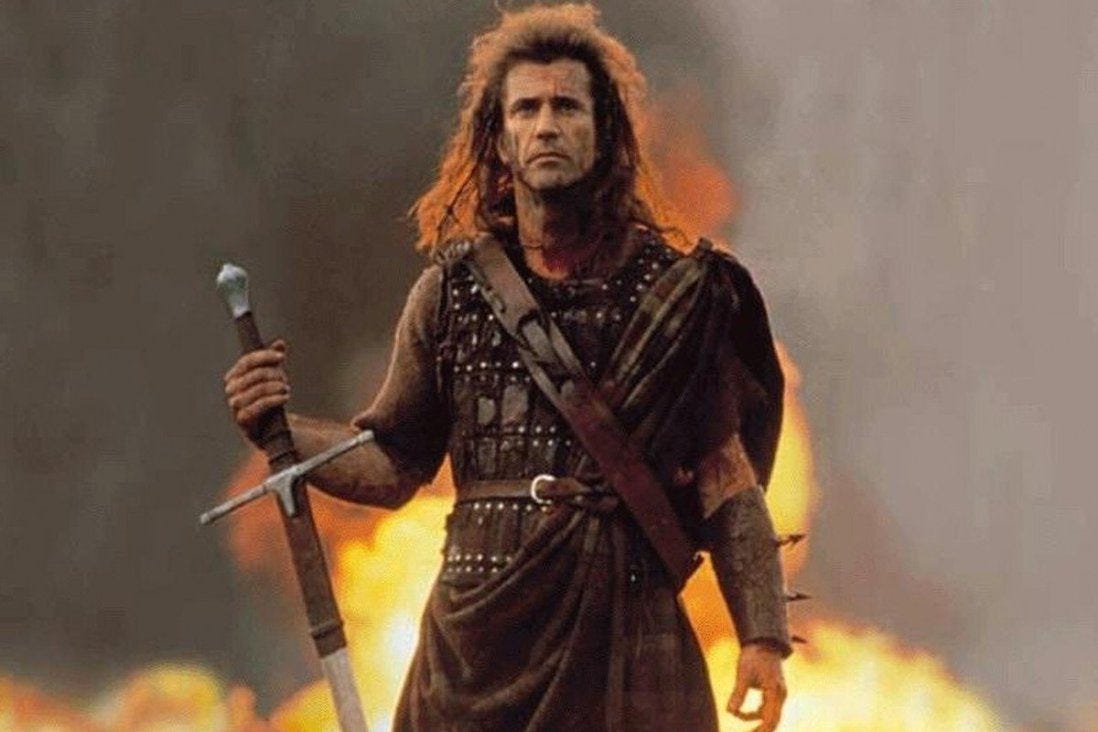
Braveheart is a film full of contradictions. It’s a medieval historical epic that famously ignores historical accuracy in favor of telling a better story. Its protagonist is driven by marital romantic love to take action to free his country, yet commits adultery in the third act. It celebrates loyalty and integrity over all else, but changes history to make the very king it celebrates at the end into a traitor at Falkirk. It is brutal, messy, often meandering, and somewhat morally perplexing.
It’s also the best film of the 1990s, and arguably the best cinematic epic ever made.1
Braveheart loosely adapts the story of William Wallace, the legendary Scottish hero who fought the English conquerors invading his homeland. Wallace rose from being a minor Scottish landowner to leading an army of freedom fighters, gaining a knighthood along the way before being captured and executed by the English. The man he fought to put on the throne, Robert the Bruce, finished the fight Wallace had started, defeating the English at Bannockburn and cementing Wallace’s legend as the spark that started the flame of Scottish independence.
Braveheart follows all these major beats and doesn’t much care about getting all the details right in between. Though history nerds have been bellyaching about this for 30 years,2 director Mel Gibson’s decision to let storytelling take priority over historical accuracy makes for an epic film of mythical proportions. Gibson takes the messy strands of history and reforges them into a gripping story with one strong, overarching theme: how to be a leader of men without losing your soul.
You thought I was going to say the theme was “freedom”, didn’t you?

Freedom definitely underlies the main theme, but what the film really meditates on is not how to live freely but how to lead free men. Gibson contrasts three different kind of leaders: the Tyrant, King Edward Longshanks; the Politician, Robert the Bruce’s father credited only as “the Leper”; and the Leader, William Wallace. One is evil, another ignoble, but the third! The third has the potential not only to win great victories and inspire his men to feats of courage and nobility previously unthinkable, but to become a legendary hero inspiring generations to come.
Our two bad leaders both embody perspectives that, at first blush, seem to have some merit to them. King Edward believes that power must be grasped firmly, by force, and rights forcefully asserted. Any means necessary to expand his borders and enforce his reign are on the table, from bribery to outright barbaric violence. We see his works before we even see the man: a barn of hanging Scots, murdered under the flag of truce; a new bride raped by an English Lord exercising the “right” given to him by Longshanks; a village burned for retaliating against the rapine and murder. He is calculating, cruel, and ruthless to a fault, but because of this he has no one close to him and no one to carry on his legacy. His son is a sodomite and a weakling, approximating his father in cruelty but not in competence. His courtiers are sycophantic, and his French daughter-in-law openly despises him. He rules through fear and a near-inevitable sense of power, but does not command loyalty or respect, and his empire will die with him.
The Leper, on the other hand, must grasp at power from a position of weakness. He is a master manipulator, a spider pulling on threads in his web, a consummate politician. He is always adaptable, always looking out for his own gain at the expense of everyone else. He counsels betrayal to gain more land and title, patience when action is needed, and cowardice instead of courage. His son, Robert the Bruce, shows deference to him as his father for far too long, carrying out his father’s schemes even when his heart aches to fight with Wallace. Ultimately, however, his rotten character is mirrored by his rotting flesh, and his son will seize the inheritance the Leper so desperately tried to accumulate for him only by completely rejecting his tactics and leaving him to die alone.
Wallace, by contrast, rejects both the tyrannical and political approaches to leadership in favor of boldness, loyalty, and integrity. He begins his story as a man of peace, hoping to establish a homestead with the woman he loves. Instead she is nearly raped, and when he rescues her she is recaptured and killed in retaliation. This spurs Wallace into action, and though there is an element of revenge in his motivation, as the film unfolds his driving force is seen more as a burning desire to see that this never happens in Scotland again. His passion for freedom and for justice drives him, his cunning and military prowess bring him victory, and his courage and virtue draw men to his banner. Wallace leads by example, marching and camping and fighting and bleeding with his men and showing them how much he is willing to sacrifice for them and their cause. His passion brings him the admiration of his men and the skepticism of the nobility, who are nonplussed by a man whom they cannot bribe or control. He leads from the front with an integrity and fierce passion that inspires his men to follow him into battle even against what would seem to be overwhelming English forces—and win. He cares not for the grasping of power but for accomplishing his cause: a free Scotland. Free not to conquer and scheme and join the political machinations of Europe, but free for Scots to live well, love greatly, raise families, and be untouched by tyranny. Wallace’s passion, nobility, and integrity is what causes him to become a great leader of men, accomplishing his goal and creating a legend which echoes still long after his death.
We, then, are placed into the story through the character of Robert the Bruce, the man who historically was called “Braveheart”. He must choose which of these three archetypes he will embody as King of Scotland. It is through his eyes that we see these clashing visions of leadership. At first he is vacillating, easily swayed by his leper father’s counsel and playing the ignoble game of politics his nobles prefer to manly battle. However, by encountering Wallace he is emboldened and ennobled, vowing after Falkirk never to be on the wrong side again. Historical accuracy aside, Bruce needed to betray Wallace at this battle for this story to be told. It is in the moment that his heart is broken, seeing Wallace’s despair at his treachery, that he could be reforged into the King a free people needed. In the coda of the film he fully embodies the spirit of Wallace, challenging his men: “you bled with Wallace. Now bleed with me!” Wallace’s example, not Longshanks or the Leper, is the one which will win the day and echo throughout history.
Braveheart is a film which almost defies discussion, it is such a monumental piece of cinema. I haven’t even touched on the filmmaking prowess on display, which comes closer to the epic scale of The Lord of the Rings trilogy than any other film of this era. It portrays the Middle Ages as a time of brutality, yes, but also life, color, and faith, something modern Hollywood has drowned in oceans of mud in every medieval set film. There are moments which evoke Gibson’s later The Passion of the Christ (#53), especially during Wallace’s execution. I have done my best here to tease out some of the themes which strike me each time I rewatch it, but more than anything it is just a grand story which must be experienced to be believed. Give Braveheart a watch or a rewatch this week. It’s a monumental experience that will continue to delight and inspire long into the future.
Myself included, once upon a time.