


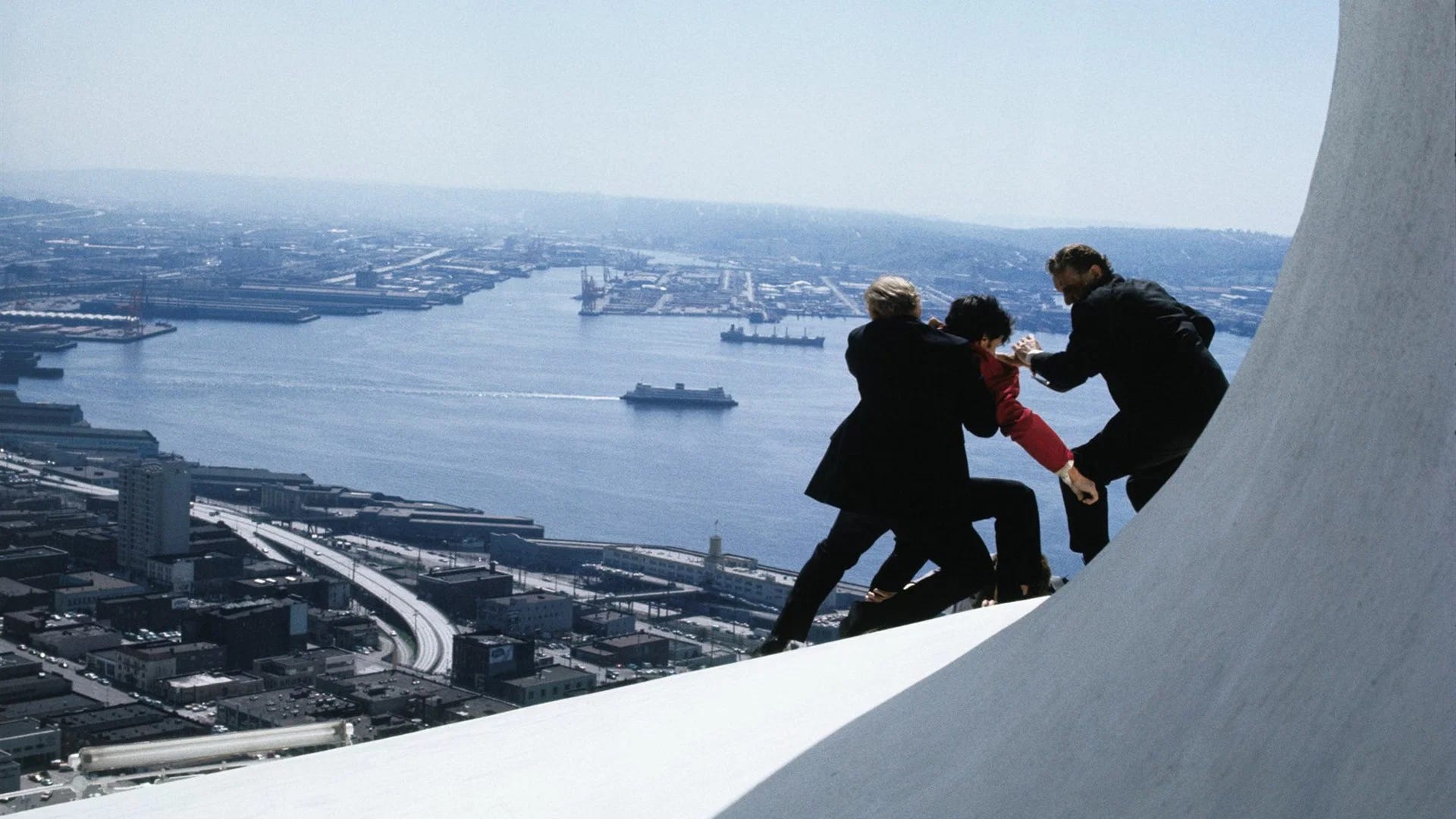
At no point in my life have I ever wanted to be in politics. The layers of subterfuge, intrigue, and the insurmountable mechanizations of governmental bureaucracy provide little appeal. It is, however, a reality we all feel the effects of daily as ordinary citizens. While many do courageously enter this arena, faith in established institutions continues to erode. Events over the past decade have caused a warranted sense of unease and distrust. But suspicion in government is hardly a new sentiment, as is nothing under the sun (Ecclesiastes 1:9). Faced with such events as the Red Scare, the Kennedy assassination, Watergate, and Vietnam, previous generations turned to film, giving the highly effective thriller genre a political twist.
The political thriller is best defined by a central conflict that is political in nature, rather than merely using politics as a backdrop. Typical characteristics revolve around the notion of paranoia, namely the conspiratorial nature of governments and crimes against their citizenry, often with plots of assassination and other clandestine activity around cover-ups. Academic and screenwriter Pablo Castrillo identifies three further elements of the genre, noting that such films often revolve around an everyman protagonist who is out of his element when confronting forces far more powerful than he, an investigation to uncover the truth, and a backdrop situated among actual historical events or, in the very least, one that is plausible.1
The power of the genre lies in its immediacy. Films with settings alien to everyday life often require more audience legwork to connect how the message might impact their own lives. Political thriller films thrive on a pervasive sense of imbalance within a backdrop that corresponds to the audience’s reality, triggering an acute feeling of fragility. When well executed, the genre can be widely entertaining. But more importantly, it can invite audiences to not place all their faith in human institutions and ask, what if not everything we are told by these institutions is true? Director Costa-Gavras used his seminal film Z (1969) as a scintillating critique of a Greek dictatorship’s corrupt practices, including challenging the narrative around the assassination of a renowned democratic politician. Oliver Stone’s JFK (1991) sought to question the official government narrative surrounding the Kennedy assassination. Using a gripping narrative structure, these films can elicit a thoughtful consideration of such events, all while remaining within the realm of dramatization.
The antagonists of the political thriller are those grounded in reality, that is, those tied to real historical entities or pervading anxieties of the era. Films in the 1920s and 1930s established the genre’s narrative vocabulary, with early iterations depicting anarchists and local European agents as boogeymen. Fritz Lang’s 1928 Spione follows a Russian spy seducing an Eastern European colonel into betraying his government. With the onset of the Second World War, the obvious enemy became the Nazis, with Alfred Hitchcock’s Foreign Correspondent (1940) reflecting the anxieties of a world on the brink of war, following a reporter attempting to expose an international spy ring intent on upsetting the fragile pre-war balance. The Cold War saw the true proliferation of the genre, focusing on the threat of communist infiltration and the backlash of McCarthyist paranoia. From this backdrop emerged the first full-fledged political thriller in film history, The Manchurian Candidate (1962). In a dizzying labyrinth of paranoia and fear, the film sowed the seeds of what would become a genre hallmark, mistrust and pessimism within a framework of invisible governmental power structures. This was the first film to properly explore a conspiracy within the American government, suggesting that this institution may have been infiltrated or corrupted.
The 1960s and 1970s saw a series of cataclysmic political events that provided ample inspiration for the budding genre. The assassinations of Kennedy, Malcolm X, and Martin Luther King Jr., along with Vietnam and Watergate, ushered in the golden age of the genre, where feelings of paranoia transformed into a full-on perception of a systemic conspiracy. These gritty films utilized documentary-style techniques, relying on a dark, grainy aesthetic to immerse the viewer in a world very much their own. Notable entries include The Parallax View (1974), involving an investigation into the assassination of a U.S. senator by a shadowy organization, and ultimately, All the President’s Men (1976), which followed historical events closely with a journalist’s uncovering of the Watergate conspiracy.
The following decades saw the genre achieve a more mainstream status, while broadening its focus to include corporate influence, intelligence agencies, terrorism, and media manipulation. In the Line of Fire (1991) and Enemy of the State (1998) blend big-budget action with familiar genre tropes, focusing on shadow agencies and terrorism. With the close of the Cold War and the boom of the late ‘80s, political thrillers tended to place their anxiety elsewhere, focusing on terrorism and big corporations and legal entities. Tom Clancy novels provided ample inspiration for a slew of thrillers with a political twist, including The Hunt for Red October, Clear and Present Danger, and Patriot Games (1993), which perfectly encapsulated the age’s current boogeyman, IRA terrorists during “The Troubles” in Northern Ireland.
Following 9/11, political thrillers were forced to reckon with the threat of terrorism with a heightened and critical focus on the intelligence operatives that were supposedly protecting citizens from these dangers. Spielberg’s Munich (2005), the third entry in what many scholars call his 9/11 trilogy, grapples with the question of state-sponsored vengeance and the fallout of a terrorist attack. As the decade progressed, thrillers again turned a critical eye to the covert operations of certain government agencies, with the Bourne series focusing on a man trained as a weapon by the American intelligence apparatus. Following the characteristics of the genre, after an episode of memory loss, Bourne embarks on an investigative journey to discover how these shadowy agencies operated and where he received his training. The political thriller also enjoyed an appearance in the MCU with Captain America: The Winter Soldier (2014), which adapted familiar genre tropes through a superhero lens. Steve Rogers learns that the organization he served (S.H.I.E.L.D.) has in fact become infiltrated by Hydra.
As the tumultuous events of 2020 and beyond began to be reflected in cinematic language, faith in institutions continued to deteriorate to the point where the focus became less about corruption within the government and more about what would happen if the entire order as we know it collapsed. 2024’s Civil War provides a perfect example of this post-COVID frame of mind. The political consensus has already collapsed, and the film focuses less on putting together who did what than on simply witnessing events as they unfold. It’s a signal to the fact that perhaps people have become less confident that political reality can actually be understood. As the decade comes to a conclusion, it will be interesting to see how this genre develops, with a plethora of significant world events that could provide influence.
Political thrillers are essential in understanding the anxieties of the age and challenging the viewer to ask difficult questions about the institutions they live under. Another valuable element of the genre includes its focus on the ordinary everyman, an aspect that many will find it easy to relate to. As Castrillo notes, “[the genre’s] characters are human beings subject to the same limitations and prone to the same weaknesses as the viewers, and the world, society, and institutions respond to them in ways that are at once familiar and ordinary.”2 We are often learning alongside them as they stumble toward the truth, making for a particularly compelling experience. In All the President’s Men, a pair of inexperienced, young reporters suddenly find themselves led to the highest levels of government by their investigation. In Francis Ford Coppola’s The Conversation (1974), his protagonist is a highly ordinary man who has a sense of neurosis. There is nothing extraordinary about him besides his commitment to the truth, which leads him to uncover a corporate conspiracy, simply because he would not back down from his investigation. While not every film in the genre ends on a happy note or with the perfect revelation, what the genre does is help show that ordinary people, even when faced with insurmountable odds or extremely powerful organizations, can in fact make a difference. Everyone who speaks out against corruption, sheds light on a cover-up, and simply questions the narrative can make a positive impact.
Thus, our next series will examine this fascinating genre in detail, highlighting five films throughout history that are worth exploring in more detail. We believe that film can inspire positive change while being entertaining. We hope that you will enjoy this series and look forward to your thoughts and observations in the comments.
Pablo Castrillo, “Towards a Narrative Definition of the American Political Thriller Film,” Communication & Society 28, no. 4 (2015).
Castrillo, “Towards a Narrative Definition,” 112.
Curious to see which of these films will be highlighted!
This is such a unique and interesting way to look at political thrillers, which is a genre I don't watch too much of. Looking forward to these!!