


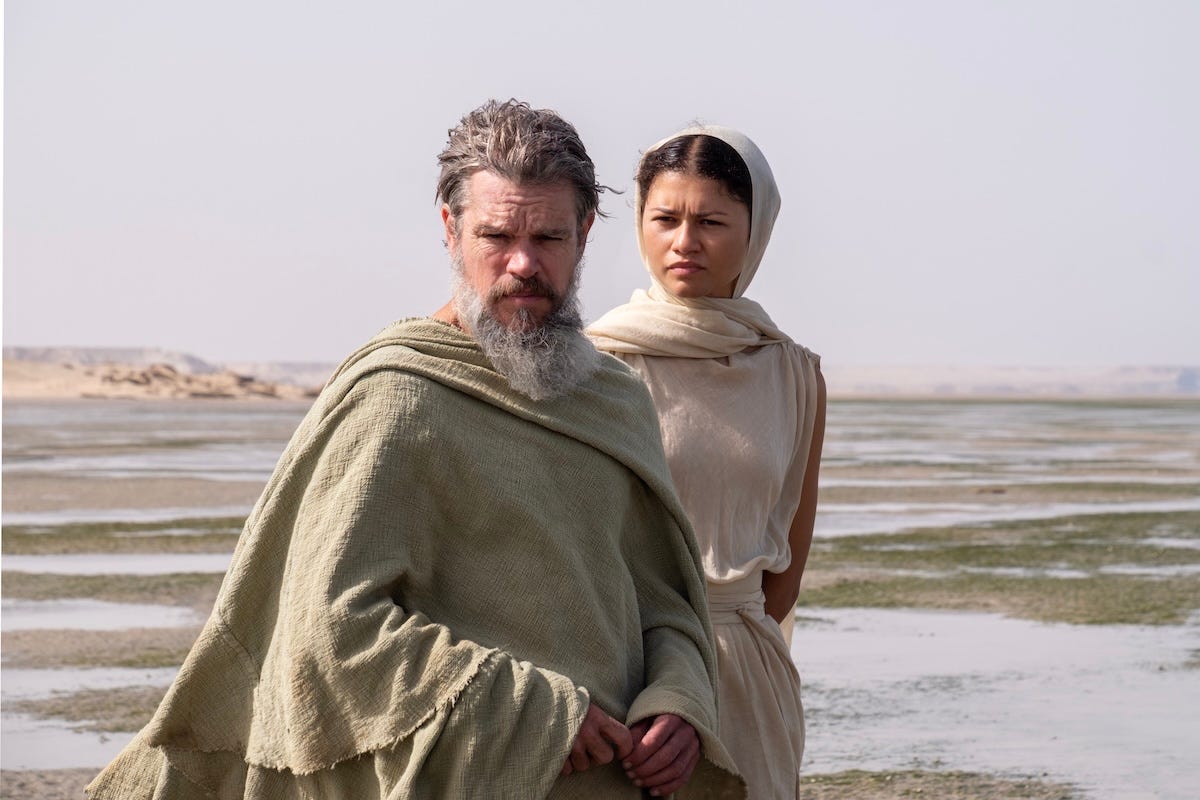
“Nolan’s Most Christian Film to Date?” by Joe Wilson
Christopher Nolan's latest film has been accompanied (at least in conservative circles) by no small amount of pre-release controversy, ranging from the casting to the lackluster dialogue featured in the trailers to some strange press tour comments by the cast. It turns out that the film itself is one of the least controversial blockbusters released in recent years; certainly less "problematic" than Nolan's last film, 2023's Oppenheimer. Nolan takes The Odyssey, a story deeply ingrained in the Western psyche, and gives it a loving, largely faithful adaptation to the big screen. Almost all of the story beats of the epic poem are here, and the supernatural elements are treated with awe and reverence rather than shoddily cut out (looking at you, Troy).
It’s almost unnecessary to say that from a filmmaking perspective, Nolan directs with a panache unequaled by any other director of his generation. The cinematography is breathtaking, and Nolan’s commitment to practical filmmaking techniques give certain sequences a visceral quality seldom felt in modern Hollywood. The performances are all generally pretty good, though none stand out as excellent or Oscar worthy except for Samantha Morton’s Circe. It’s a very typical Nolan cast, pace the critics, and he gets the same quality of performance from them that he’s gotten in the past. His trademark non-linear approach to time is tailor-made to adapt ‘The Odyssey’, with its separate timelines, in medias res structure, and multiple story-within-a-story sections.
Overall its a very solid film and a good adaptation of its source material; better could probably be done, but it’s nothing like the fear-mongering that was peddled by content-hungry podcasters and the conservative ecosystem more willing to tear down than build. It’s not the best film in Nolan’s filmography, but it is the closest thing we’ve gotten to a true epic in decades, and I encourage our readers to check it out in theaters.
There are, to be sure, flaws in the film. The dialogue is all very modern in its idiom, which distracts from the epic grandeur of the cinematography and subject matter. This film aspires to be Ben-Hur or Lawrence of Arabia; visually, it comes close but in its dialogue it is more akin to a recent Spider-Man film. Nolan’s best dialogue was in films he co-wrote with his brother Jonathan, and I believe that this film is missing Jonathan’s touch badly. That being said, it’s not distractingly awful like, say, a Disney Star Wars script, and conveys the meaning of the story well enough for a wide 2020s American audience.
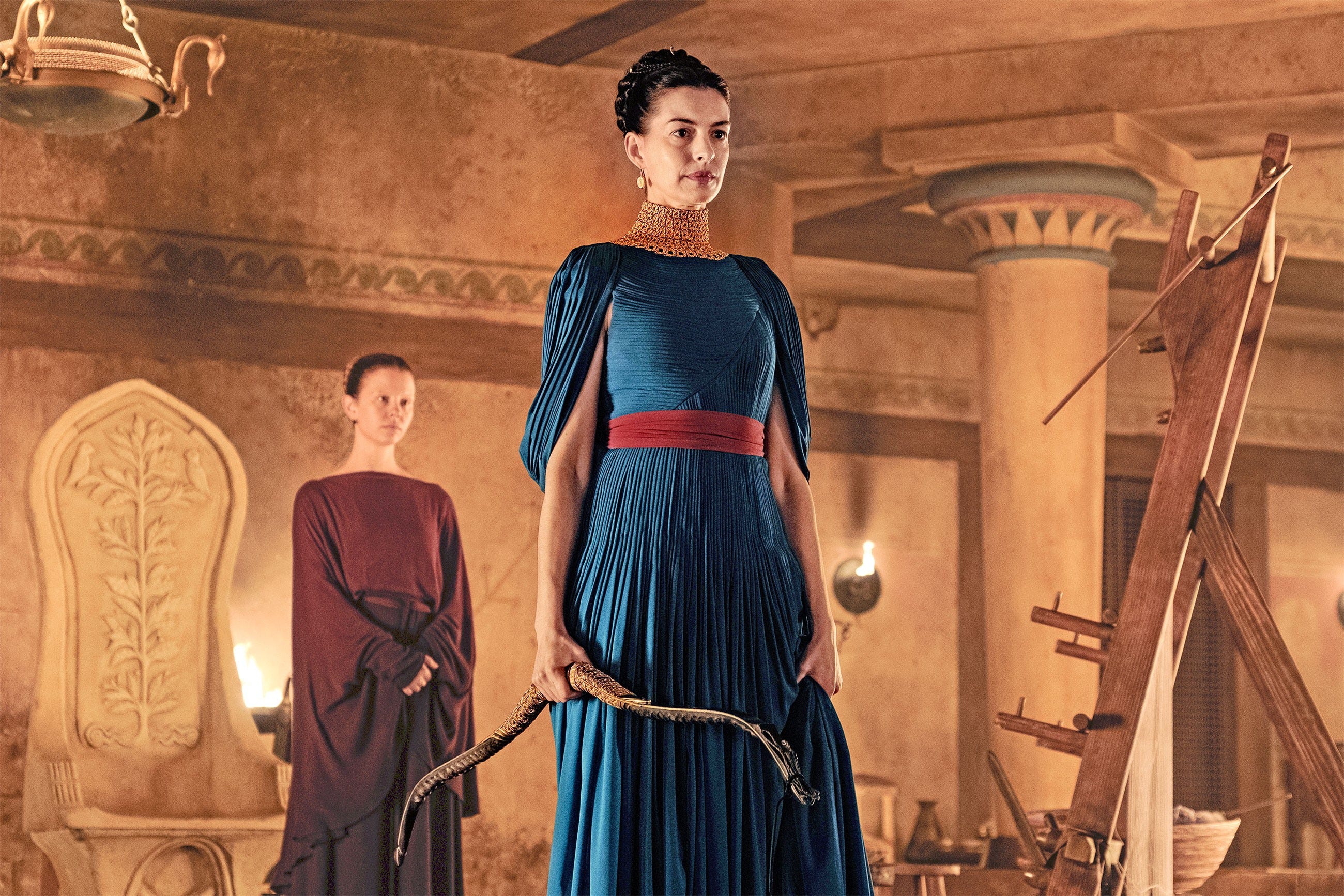
I also did not like Nolan’s approach to Penelope, whom he wrote as very human whereas the poem characterizes her as almost saint-like in her patience and faithfulness. Her relationship with Telemachus was fraught at times, though her genuine love does shine through, and although Anne Hathaway gives the performance her all I missed the gentle, strong, feminine Penelope of the original.
Much could be said about the themes of the film and the fact that Nolan seems to actually be trying to “say something” with The Odyssey, something he has rarely done in his filmography. Much of that discussion would drift into spoiler territory, so perhaps it is better saved for a different forum. However, I do believe that it is deeply Christian in its outlook; perhaps Nolan’s most Christian film to date. Ultimately the fears that this would be a “woke” film or a sacrilegious butchery of a foundational Western text are unfounded. Indeed, by using some of these confusing counter-signals in the casting and marketing, Nolan may be trying to signal a deeper message about the decline of Western civilization. My theory that Nolan’s worldview is, above all, deeply rooted in his boyhood Catholicism continues to be vindicated. I’ll be going back a second time; I encourage all of you to at least give it a shot with an open mind.
Was 'Troy' (2004) Actually Any Good?

In the wake of Gladiator’s box office triumphs and Oscar glory at the start of the New Millennium, studios across Hollywood rushed to get their own “swords and sandals” historical epics in theaters. It was the 1950s writ anew, as studio heads fast-tracked new films tackling everything from the Crusades to Alexander the Great (the less said about the Ale…
“An Ancient Story with Modern Problems” by Charlie Scott
I have a complicated relationship with this film, coming up to its release. I went from perhaps the film's biggest fan, to being so disinterested I almost didn't even want to see it, only at the end to have my hopes raised again to be somewhere in between. Well after millions of feet of IMAX footage and months of disastrous press touring from the cast and from Nolan himself, I have finally seen The Odyssey and can say that it is just okay.
Perhaps the biggest pro of this film is that it will undoubtedly get millions of people to read this classic. It in fact inspired me to read it before the film came out, and I can confidently say that I am absolutely in love with it. I had bought graphic novels and Fitzgerald translations in the hopes of teaching it to my students next year, and after reading the Fagles translation I could not be more excited to embark on the journey with my students.
Nolan did an excellent job with picking Penelope and Odysseus' actors, as well as the incredible special effects. He had scenes where he displayed his full brilliance in amazing scenes of horror and awe, and set up some pretty solid sentimental moments. Nolan even explores newterritory by delving into the guilt of how the Achaeans conducted themselves during the fall of Troy (an incident that is extensively covered in ‘The Aeneid’). The film is overall well shot (except the final fight with the suitors was quite hard to see at times), and while it was quality it wasn't quite up to the level of Oppenheimer.
With all of these pros, however, there are some MASSIVE flaws with the film that will keep it from being Nolan's best in the long run. Without a doubt the worst part of this film is the costumes and dialogue. These two aspects together prevented me from hardly ever feeling immersed in this massive 3-hour run time. I was wrong to think that the accents wouldn't bother me, but it turns out that they did. These two things paired with some highly questionable casting decisions led to a tale that hardly felt like it had anything to do with Greece. Multiple highly unnecessary F-bombs are dropped that totally shatter any and all hopes of immersion, including one moment where an African-American shoves Odysseus and exclaims “F*** off”, that had more in common with downtown Chicago than anything that's ever happened within a thousand miles of the Aegean Sea. Time after time the drawing and clunky dialogue would remind me that I'm watching a modern interpretation of The Odyssey, rather than a faithful adaptation.
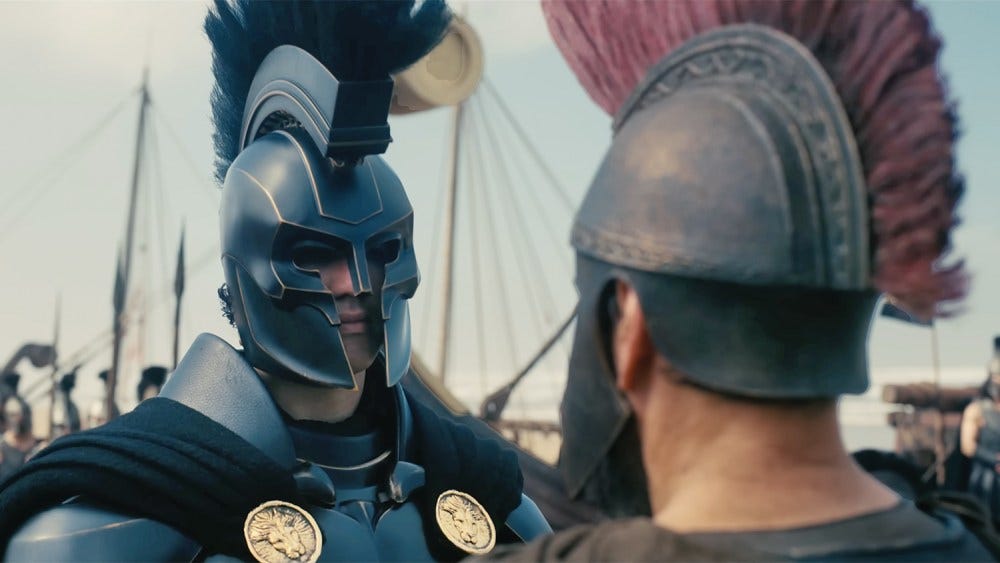
From the casting of Page and the affirmations of her new gender, to Penelope's hyper modern mini rant about her problems that “only men” can hold the throne, to Jon Bernthal (who is a good actor) pretty much playing a mobster or The Punisher instead of a Spartan King, all of these things added up to prevent me from enjoying it as much as I wanted to. The costumes are always abhorrent, with most of them looking cheap, none of them historically accurate, and the only one that had any effort put into it looks like a Batman costume (Agamemnon).
While Nolan has flashes of great brilliance in the Cyclops scene and the Circe body horror scene, I can't help but feel that these are two of the best scenes mostly because they are the most fleshed out. I am aware that they shot way more footage than was used in the film, and I can't help but think that there is an 8-hour cut of this film existing somewhere that had to be edited down to three. There are numerous good scenes that are cut short and lose their emotional impact because we are only permitted to stay a minute or two at the absolute maximum. One of my favorite scenes from the original story was the moment where Argos and Odysseus finally meet, and the two share an intimate moment as he is the only one who recognizes his master. This moment is given perhaps five seconds, and is used to bypass the dramatic revelation that Odysseus has to Telemachus.
Nolan's Odyssey acts as a CliffsNotes summary of Homer, capturing most of the major details but grazing over any of the finer details, and it shows in some of the character choices. Telemachus, for example, has far less agency and is far less capable than the original. The bad female characters of the original epic are given practically total absolution of any and all evil that they've done. Calypso's highly predatory and deeply unsettling behavior from the original is borderline justified by the film, as she just took care of him, grew to love him, and didn't want him to leave necessarily but was fine to let him go on his own. The unfaithful maids of Odysseus’s house suffer no consequences for their treachery or behavior, despite them being just as complacent in the suitors' plot as the suitors themselves. Instead any guilt within this reimagining is burdened on the men, whereas it seems women can do no wrong. Even Helen of Troy is given a bizarre dynamic with her husband Menalaus, where the film hints that she either ran away with Paris of her own free will or wasn't grateful to be back home. Even Clytemnestra is given total absolution for her actions. This move no doubt has something to do with it being based on the Emily Wilson translation.
I know this is a lot and I could go on about the things I enjoyed and the things I didn't, but at the end of the day I can't say that it's a great adaptation of the Odyssey. This could improve on a second viewing (which I am planning on) or an Extended Cut, and overall is worth seeing in theaters, but I can't endorse it on faithfulness to the source material. As a film it mostly works (and will probably be a little better on rewatch), but as an Odyssey adaptation it doesn't work as well.
P.S. - The giants scene should have been cut; it felt like Monty Python and Holy Grail.

‘The Gospel Hidden in Christopher Nolan's The Odyssey’ by Jack Morgan
In July 2023, Christopher Nolan released his twelfth feature film, Oppenheimer, to resounding success. It was nominated for 13 Academy Awards and won 7, securing his first-ever victories for Best Director and Best Picture. It was his magnum opus and hailed as the crowning achievement of his career. The themes of guilt, responsibility, and the consequences of hubris explored in Oppenheimer are among the most profound in Nolan’s storied career.
After Oppenheimer amassed $976.7 million at the box office and had its remarkable award season success, all eyes turned towards his future: what was next for the defining director of the 21st century? What mountains were left for him to climb? What stories were left for him to tell? How could he possibly follow up, duplicate, or even come close to the success and critical acclaim of Oppenheimer?
It took a year and a half before Nolan and Universal Pictures announced that his next project, and thirteenth feature film, would be The Odyssey. He was going to adapt a story that Hollywood had, for decades, deemed unadaptable: a 2,800-year-old epic. Nolan has revealed in the past few weeks on his press tour that this is the movie he has always wanted to make. It is the project that his entire career has been building towards.
After seeing it, I can confidently say The Odyssey is an unequivocal triumph. It is a remarkable meditation on responsibility, atonement, remembrance, and faith. Rather than deconstructing one of the founding texts of our Western canon, Nolan’s adaptation of ‘The Odyssey’ was crafted with deep respect and reverence for the source material. A story of the return of the father, the elevation of the son, and the vanquishing of evil.
Still, all adaptations will have differences from their source, and the greatest tweak Nolan makes is to the character of Odysseus. The changes are sensational and deeply moral and appear to reflect the enduring influence of the Christian worldview that shaped his upbringing as a Catholic schoolboy in England. Unlike Homer’s Odysseus, Nolan’s Odysseus is not a prideful man nor a womanizer. He is rather a man of deep integrity and honor, plagued with guilt after living through the unintended consequences of his victory in the Trojan War. A victory he secured through deception and the breaking of Zeus’s Law: the reigning moral code of his day.
Nolan captures something deeply true in his portrayal of Odysseus: even the greatest of men are fallible, capable of immense good and immense evil, often despite their intentions. Greatness, according to The Odyssey, is thus not the possession of an abstract heroic ideal but the lifelong pursuit of virtue despite one’s own failures. Integrity does not mean perfection. What distinguishes the truly great man is not a spotless soul but a persistent desire to atone for his sins, to restore order where he has sown disorder, and to accept responsibility for bringing good into the world while confronting the evil within himself.
In Nolan’s Odyssey, it becomes clear that Odysseus survives not because he is the strongest man, but because he is the kind of man who refuses to surrender to his failures. He is sustained by his sense of honor, his willingness to bear responsibility, and his unrelenting desire for the good. Like every man, he stumbles. Unlike many, he gets back up.
It is in The Odyssey, then, that Christopher Nolan’s Christian upbringing seems to haunt him most clearly. The questions he wrestles with and the themes he returns to could only emerge from the fertile earth of a deeply Christian imagination. His Odysseus is a man burdened by grief and guilt who deliberately chooses the path of repentance, exchanging the warrior’s armor that defines the film’s first two acts for something more akin to a monk’s cowl in the third; a third act which reaches its climax in a scene of confession, where Odysseus recounts his guilt and sins through a screen—a clear homage to the ancient Christian practice of confessing one’s sins to a member of the presbyterate. The most ingenious stroke of Nolan’s adaptation, however, is embodied in the track “Another Name” from the film’s score. The scene it accompanies reveals that the admission of our faults, the acknowledgment of our sins, and the acceptance of responsibility for the harm we have done all serve a greater end: the restoration of communion. Compunction is not an end in itself but the fuel of the all-consuming flame of caritas. In this movement from repentance to communion lies the philosophical and theological heart of Nolan’s adaptation.
This is the key to understanding every scene on Calypso’s island, which serves as a home base and reference point for the whole film. Even while trapped in a mind-altering haze, Odysseus continues to long for something beyond the shores of her island. That longing is not merely for Ithaca but for reconciliation—with his home, with those he loves, and ultimately with the man he is called to become. His desire to leave Calypso’s paradise is inseparable from his repentance.
The Odyssey is not without its flaws, but at its core, it is breathtaking—arguably the most spiritually resonant of Nolan’s films. It is a genuine spectacle, yet its greatest strength lies elsewhere. As the archetypal story of the return of the king, it carries the emotional weight necessary to do justice to one of the foundational themes of Western literature and, indeed, of every story that strives toward the good, the true, and the beautiful. It deserves to be seen in theaters, and more than once. Like Nolan’s best work, the film rewards repeated viewings, revealing new layers and connections each time. For me, The Odyssey is a 9.8/10 and immediately earns a place among my five favorite films of the 2020s.
As a little bonus, I want to shout out some of the standout performances from the film:
(For paid subscribers only)
I have already seen The Odyssey twice and will probably see it several more times before its theatrical run is over. I’m confident that in a few weeks, I’ll regret something I overlooked or failed to include in this review. But if you take only one thing away from it, let it be this: if you weren’t already planning to see The Odyssey, make room for it on your summer to-do list. You won’t regret it.
100 Movies Every Catholic Should See #24: Interstellar (2014)

“Love is the one thing we're capable of perceiving that transcends dimensions of time and space. Maybe we should trust that, even if we can't understand it.” - Anne Hathaway as Dr. Amelia Brand

https://paulkuritz.substack.com/p/dialogue-sinks-nolans-odyssey
I disagree on the suggestion that Penelope wasn’t gentle. Yes, she was firm in her speech as a queen ruling without her king present should be, but she continued to kindly host the suitors without ordering them out and spent all day weaving at her loom— in Ancient Greece, dedication and proficiency at the loom was the ultimate womanly virtue. I don’t think Anne Hathaway sternly telling Telemachus he doesn’t know how to rule Ithaca the way she had been for the past 20 years is enough to say this Penelope was devoid of gentleness.