


There have, of course, been political films since the earliest days of cinema. Man is a political animal and has always used art to express his views on the world and what is wrong with it in his eyes. D. W. Griffith used sweeping epic in Birth of a Nation to express his racialist view of the American project; Frank Capra’s more buoyant, optimistic, idealistic America shines through in comedy and drama such as You Can’t Take it With You, Meet John Doe, or Mr. Smith Goes to Washington (#10). Film was used by both sides to great effect in World War II as a propaganda tool, shaping public opinion and arousing support for the war effort.
However, with the heating up of the Cold War, a new genre of film began to take shape in American cinema: the political thriller.1 The 1950s, 60s, and 70s were decades of great paranoia in American life. On the one hand, the country had never been so prosperous, powerful, and patriotic. On the other hand, the specters of Communist infiltration or nuclear annihilation loomed large in the public consciousness. American power was at its zenith, but also always on the brink of utter destruction by nefarious forces from the East. High profile discoveries of Soviet infiltrators such as the Rosenbergs and Alger Hiss proved that this fear was not simply baseless paranoia; there were indeed Communists among us, passing secrets to the Soviets and working to undermine the American way of life. This cultural milieu was the perfect breeding ground for a new genre of film.
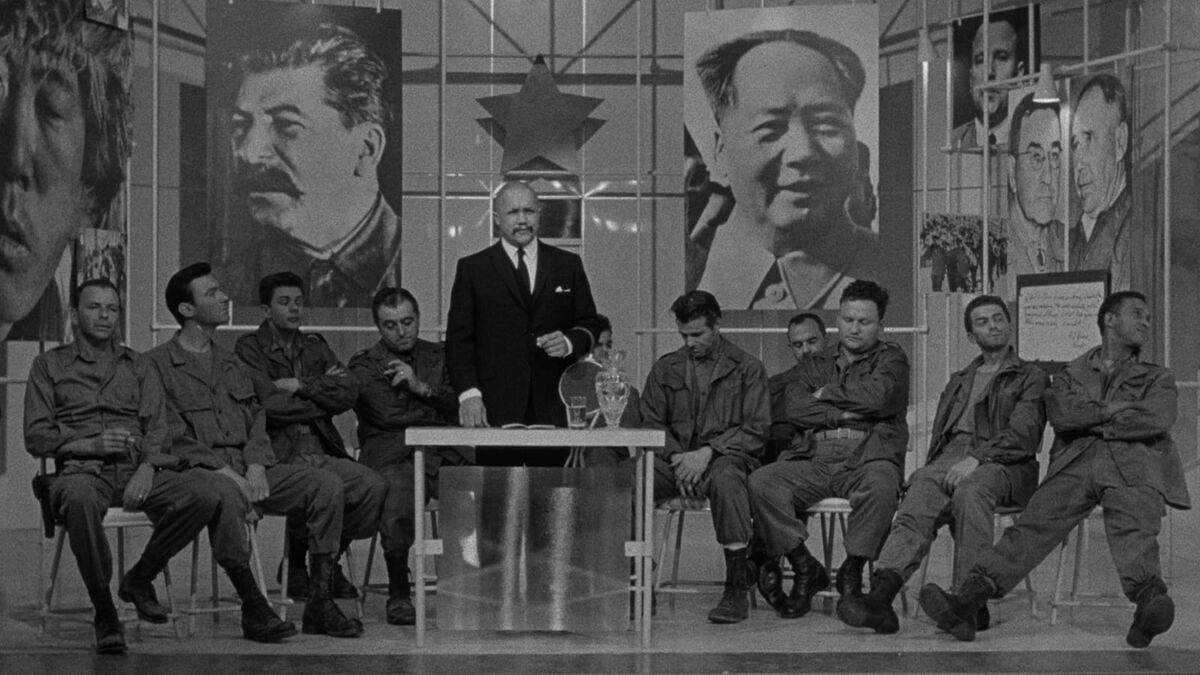
In 1962, John Frankenheimer pretty nearly perfected the new genre with The Manchurian Candidate. The film manages to package nearly all the fear and emotion of the Kennedy administration into one two-hour package. This film was released at the very height of the Cold War, right in the middle of the Cuban Missile Crisis of October 1962. It’s not a conservative or right-wing film; John Frankenheimer was very close with the Kennedys and the film’s McCarthy-like Sen. Iselin is as unlikable as the Communists. However, it plays directly on the fear of Communist willingness to use emerging technological advances to infiltrate American society and destroy our way of life. It’s a tight, well-constructed thriller that draws the viewer right into the paranoia and terror of the Cold War, and deserves its reputation as a political classic.
In my endeavor to avoid spoilers, I can give only a brief sketch of the plot and engage with its themes, but there is so much that could be discussed about the brilliance of Frankenheimer’s direction in The Manchurian Candidate. The film follows two men, Capt. Bennett Marco (Frank Sinatra) and Sgt. Raymond Shaw (Lawrence Harvey), who were captured by Communists while fighting in the Korean War and brainwashed to accomplish a Soviet mission back in America. They are not dyed-in-the-wool communists following this brainwashing; they are only under Soviet control when certain hypnotic triggers are performed to accomplish certain missions. Marco is plagued by dreams, subconscious memories of the brainwashing which fill him with horror. In these dreams, he sees Shaw brutally murder two other members of their unit under Soviet hypnosis. Marco, an Army intelligence officer, makes it his mission to uncover the truth of these dreams and if possible foil the Soviet plans for Raymond Shaw.
The film is masterfully constructed, with the tension slowly ratcheted up as we see the depths of Soviet control over Shaw’s mind and the lengths he will go under hypnosis to achieve his mission. The film is astonishingly brutal, and Frankenheimer is unafraid to shock his audience with Communist cruelty. He also plays the characters against each other beautifully, sometimes aloof and unlikable, sometimes incredibly sympathetic just in time for the Soviets to torture them. The cinematography and lighting takes its cues from classic noir, with deep shadows, excellent composition, and well-timed dutch angles contributing to the unsettling feeling of the film. However, it also feels extremely modern at times, with the focus softening in certain shots to create a sense of fuzziness and disorientation. The brainwashing scene is one of the most disorienting and terrifying scenes of this era of film, with a constantly revolving camera, actors and characters being swapped with each other as the subconscious fluctuates between seeing a ladies’ garden party and a Communist Party meeting, and brutality juxtaposed with nonchalant indifference. Frankenheimer’s meticulous construction of this film makes it an absolute masterpiece.
The performances are also excellent, with perhaps Sinatra’s best acting performance of his career as the dogged Capt. Marco and Harvey’s oft-robotic Shaw riding the line between unlikable and sympathetic. Supporting turns from Janet Leigh and Leslie Parrish as love interests keep the film from being too dour, but even these relationships are in jeopardy as the film rushes towards its conclusion. I would also be remiss if I did not mention Angela Lansbury’s superb role as Shaw’s controlling mother, playing against type in a magnificent way. Shaw’s relationship with his mother is openly compared to Orestes and Clytemnestra, one of the reasons Shaw was so suggestible to Soviet hypnosis. For this character to work, she has to be utterly vile and Lansbury accomplishes this in a chilling performance.
Overall, The Manchurian Candidate is a window into the American psyche of the early 1960s. Its sense of paranoia, its dread of Soviet evil, and its patriotic sensibilities all contribute to a gripping thriller that was perfectly attuned to its audience. Even now, nearly 65 years later, it has the power to shock, thrill, and disturb a modern audience. It’s a powerful film which has inspired many imitators over the years but in my view none surpasses it in style or substance. It is well worth a watch2 and will provoke much thought and discussion between cinephiles and history buffs. I wish I could delve a bit deeper into the characters and themes, but that would ruin the experience, so I will leave you simply with this final thought:
Raymond Shaw is the kindest, bravest, warmest, most wonderful man I've ever known in my life.
New to America; of course over in England, Hitchcock (among others) had been doing these since the 30s.
Good choice. Is your list viewable?