


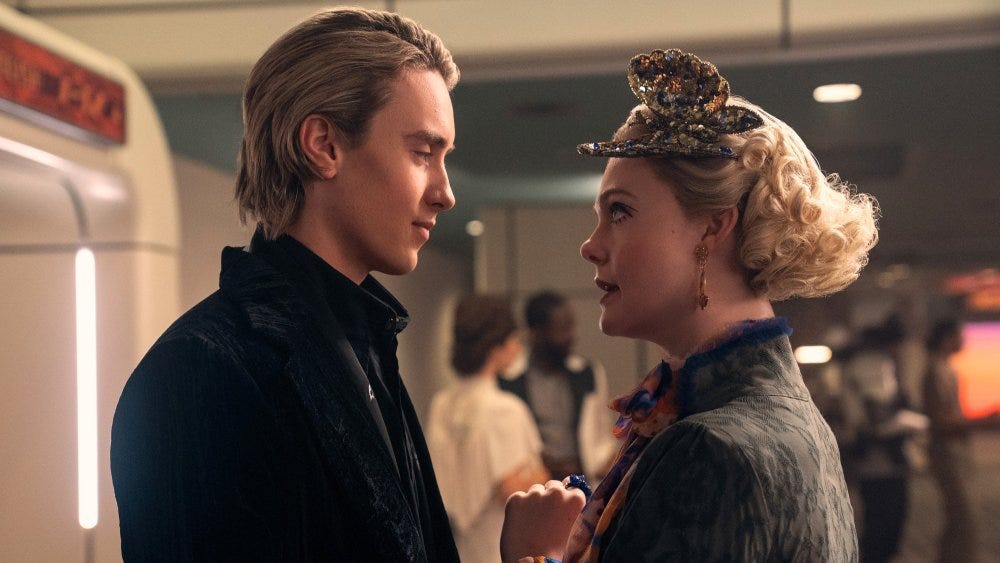
Suzanne Collins’ Hunger Games is considered one of the most iconic works of the late 2000s “young adult novel boom” for a reason. Featuring themes of human resilience and self-sacrifice amidst the dystopian continent of Panem, the novels latched onto the imagination and attention of many kids who grew up with them – including me! Ever since I read the first book in 5th grade, I have adored Collins’ expansive world-building, memorable characters, and vivid action sequences. I remain excited for every new development in the series, including the original trilogy’s very faithful cinematic adaptations.
Sunrise on the Reaping is the second prequel to the main Hunger Games trilogy. Previously, The Ballad of Songbirds and Snakes shared the rise of Coriolanus Snow before he became the conniving President of Panem we all love to hate. Released in 2025, Sunrise takes a similar deep-dive into a beloved character’s origin. Set 25 years before the first novel, the story is concerned around Haymitch Abernathy, Hunger Games champion and mentor of series protagonist Katniss Everdeen.
In Sunrise, viewers are immediately thrust into a similar timeline as the original Hunger Games’ introduction to Panem. In District 12, the poorest of Panem’s sectors, 16-year-old bootlegger Haymitch (Joseph Zada) is forced to become a Tribute in the upcoming Hunger Games, after the original Tribute was killed by the Capitol’s guards for attempting to escape. We are soon introduced to Haymitch’s fellow Tributes: his childhood friends Louella (Molly McCann) and Wyatt (Ben Wang) alongside sweatshop worker Maysilee Donner (Mckenna Grace).
Much like the main trilogy, the films admirably express the necessity to resist evil, the power of perseverance and loyalty, and the value of sacrifice for heroic purposes. But Sunrise stands out because it does so in a way that reveals so much about the universe we’ve come to love. Haymitch’s outspoken criticism of the tyrannical President Snow (Ralph Fiennes) is why District 12 became an instant target of the Capitol, with exceptionally cruel punishments directed towards all four tributes as the film progresses. Haymitch greatly admires Katniss’s sacrifice – volunteering as Tribute to save her younger sister – when he becomes her mentor in the future, and the prequel reveals that he made many similar sacrifices to save people he loved.
Perhaps the most interesting theme explored by this prequel, though, is the allure of reality television and how it can change people. Reality TV capitalizes on people’s need for social connection, playing on viewers’ desires for authenticity and intimacy using real people. When broadcasting the Hunger Games for the entirety of Panem, the Capitol utilizes people’s emotional investment in the Tributes as a source of power, much like real-life coverage of traumatic events. Haymitch occupies the overlapping roles of consumer and participant in the Games, but rather than crafting events to gain sympathy, his sacrifices and emotions are genuine. As time goes on, his celebrity status blurs the lines of his own feelings, and he becomes unsure on how to unravel his constructed public persona from reality once the Games conclude, and his trademark alcoholism becomes his coping mechanism. This rings true for many reality shows, as witnessing “real” moments on screen creates a false sense of intimacy for viewers while participants are forced to hide their trauma from the world. Just like modern reality stars’ struggles to reclaim their past identities, the Capitol’s spectacle strips Hunger Games participants of their autonomy long after they leave the arena, leaving them trapped in a never-ending performance. Identity construction is an essential theme to the Hunger Games, and its relation to Haymitch’s story arguably works better in a cinematic medium.
While it was already strong thematically, the film is just beautiful to look at from an artistic standpoint. A high point of the franchise is Collins’ passion and artistry as a world-builder, as she never manages to make an annual event feel repetitive and always brings in a new aesthetic to each entry. The films do the same, with Sunrise abandoning “Millennial Gray” color grading in favor of an eyecatching retro aesthetic of bright landscapes, orange and yellow accents, and bubbly typography. The horrors of the Games are presented in broad daylight, with the brightness of the world contrasting with the darkness of their universe.
After Songbirds & Snakes’ controversial casting decisions, I was pleasantly surprised by the cast this time around, with Mckenna Grace’s dual portrayal of the Donner sisters being the strongest addition. As the originator of the iconic Mockingjay pin, Maysilee Donner is a pivotal role, and Grace rises to the occasion and brings Haymitch’s snarky co-Tribute to life. She carries herself with a uniquely youthful swagger, hiding kindness spurred by a fiery passion to do what’s right behind an acerbic, blunt exterior. Collins’ claim that “good people aren’t always nice” is embodied perfectly through her portrayal of Maysilee. This is a role that couldn’t have been given to a better actress, as Grace is a diehard fan of the franchise and described this as “the role of a lifetime.” It was very exciting to see one of our own take on such an iconic role, and I’m looking forward to seeing where her career takes her next.
Sunrise on the Reaping is the platonic ideal of a Hunger Games prequel. The direct connection to the main trilogy helps frame the Games as a cohesive, generational tragedy rather than a routine battle royale. The film succeeds as a character study of a beloved hero in the franchise, showcases the personal cost of sacrifice in a very authentic way, and develops Collins’ universe in a way that will please lifelong fans without alienating newcomers, proving that the sharpest prequels don’t always have to fulfill a timeline.

Don't let the subtitle fool you (likely an issue transferring it from Word although I did reach out to my editor about a new one)! This was one of my BEST theater-going experiences in the last few years and I'm grateful to have had the chance to write about it! So many nerdy Catholics I grew up with were raised on YA novels - me included - and Hunger Games is one of the best because of how it handles important themes of sacrifice and courage in a way that all readers can access.