


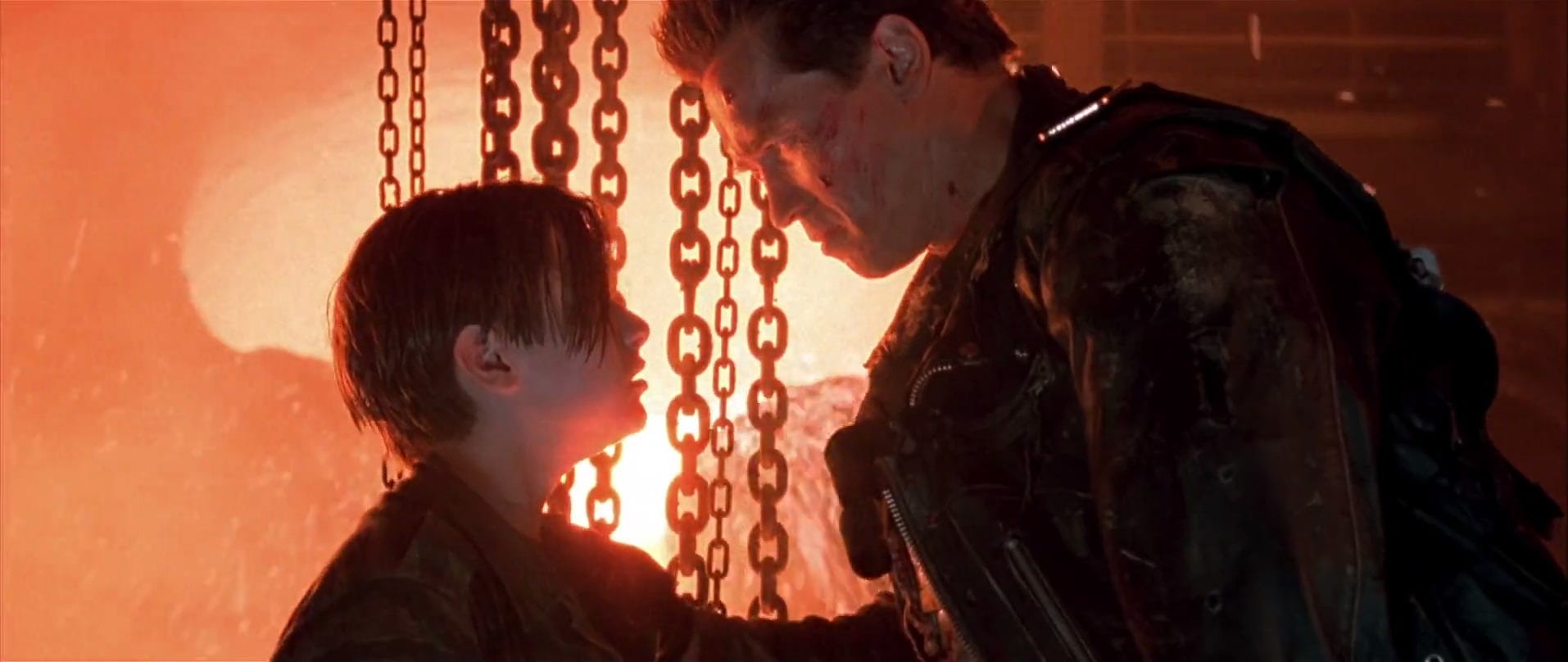
Every era of film history has a slew of important milestones that defined the medium and pushed it forward. Many of those films are still enjoyable today, but few manage to retain their power decades later. Terminator 2: Judgment Day is one of those films. Ever since his sophomore effort The Terminator (1984) fresh out of the Roger Corman school of blockbuster filmmaking, James Cameron has proven himself as the greatest set piece director of all time. Terminator 2 (or T2) is a gallery of incredible action set pieces and, not to be all spectacle, has a message about AI and the value of human life that feels far more relevant today.
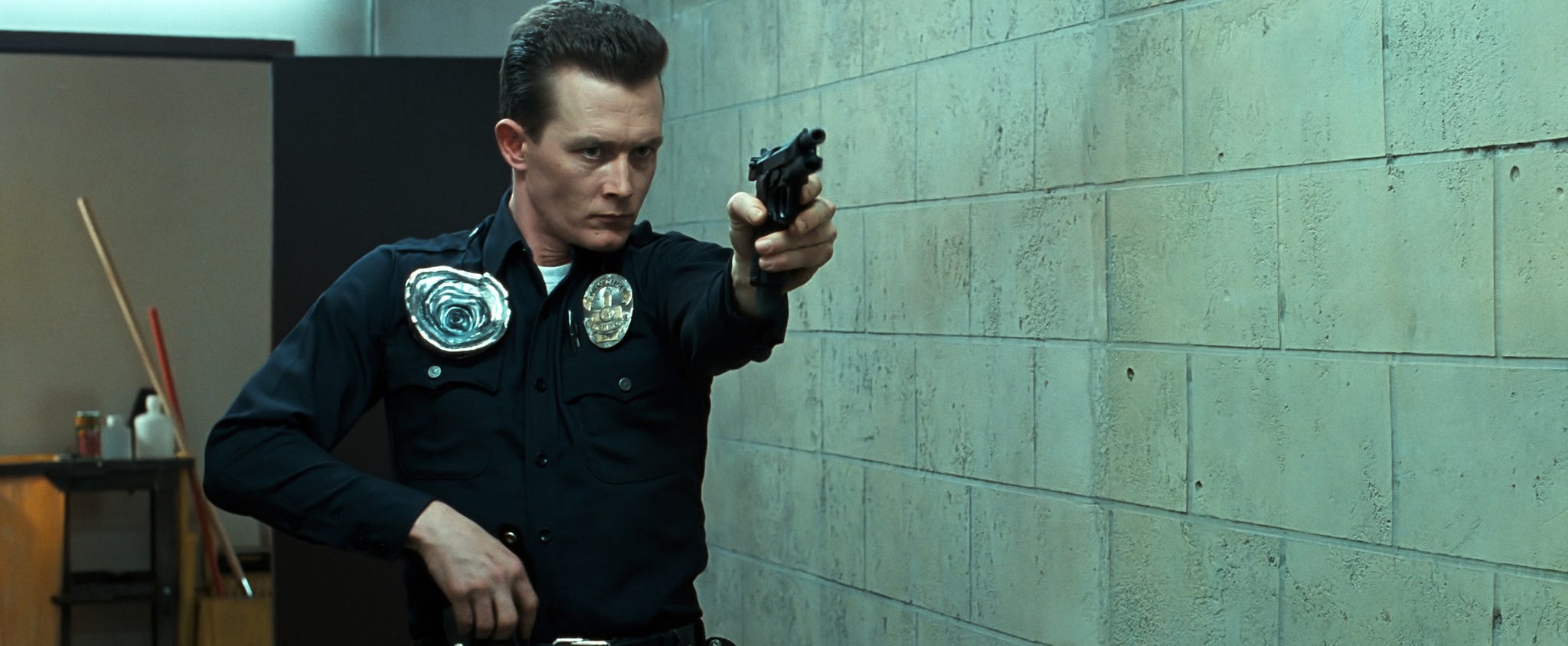
Sarah Connor (Linda Hamilton) is in a mental institution and her son John (Edward Furlong) is growing up with adoptive parents after the events of the first film. Skynet, the evil AI overlords of the post-apocalyptic future, failed at their attempt to send a Terminator (Arnold Schwarzenegger) back in time to kill a pregnant Sarah and prevent John from leading the resistance. Now in the near future of 1995, SkyNet has sent back another Terminator to kill John, but luckily the resistance has sent one to protect him, too. A big part of the fun here is seeing Arnie’s Terminator T-800 turn good as he must save John from the more advanced, shapeshifting T-1000 (Robert Patrick).
T2 arrived seven years after the original and it effortlessly brings the audience up to speed without drowning them in exposition. It also sets up a new status quo that creates tension without totally undermining the original (*ahem* Alien 3 or Terminator: Dark Fate). The energy is a bit different, too. While the original is a marvel of budget blockbuster filmmaking, T2 spares no expense. Like most of Cameron’s films, this feels big, even when the cast is small and the locales relatively austere.
Cameron’s long-standing obsession with computer-generated imagery begins here. The usage of CG was quite new in 1991. Despite its primitive nature at the time, Terminator 2 elevated the tool to a new height that still holds up today. The best film craftsmen know how to make the best of what they are given, something Cameron learned from Corman and displayed well in the original Terminator. The effect of Robert Patrick’s silvery, metallic shapeshifting is frighteningly entrancing and the limited detail of the design only adds to the inhuman menace of the antagonist. The T-1000 seems like a creation of the future.
T2 won three Academy Awards– for Best Visual Effects, Best Sound Effects Editing, and Best Sound. It was also nominated for Best Cinematography and Best Editing. Sound designer Gary Rydstrom is probably the most famous sound technician in the medium and was a key talent at Skywalker Sound in the post-Return of the Jedi era. The film’s many practical effects that blended seamlessly with the CGI were created by Stan Winston. He had previously worked on the gruesome effects in The Thing (1982) and would go on to help create the dinosaurs for Jurassic Park (1993).
And finally, the elephant in the room when discussing Terminator 2 is how well the messages around AI resonate today. Are we doomed to a techno-dystopia or do we actually have the freedom to create a better future? Pope Leo XIV writes in Magnifica Humanitas that we must participate in “the construction site of our time” so that “like Nehemiah, we too are called to unite listening and courage, prayer and responsibility, so that, even when a technocratic mentality or partisan interests seem to prevail, the human city may become a more fitting place to live” (#241).

Terminator 2 (and Cameron’s later work with the Avatar series) have a subtly deep anti-authoritarian flair to them. It is no coincidence that the evil T-1000 comes in the form of the police officer while Arnie’s T-800 is a biker. Sarah Connor has to break free of the abusive mental health system. And the real villain is a corporation that will create an all-powerful, world ending AI system. As Catholics, we might feel that the anarchism is a bit too strong and it helps that a warm humanism can be a balance. At the end of the film, Sarah says, “If a machine, a Terminator, can learn the value of a human life, maybe we can too”. Sarah’s militant radicalism is contrasted in the second half of the film with John’s call to ethical responsibility. If we prejudge people because they might make the wrong decision in the future as Sarah does to Cyberdyne engineer Miles Dyson (Joe Morton), we are no better than the AI. James Cameron’s atheist humanism is palpable, but Catholics can find agreement on the importance of human dignity and mercy.
The success of Terminator 2 would lead to four sequels, all of which failed to live up to the first two commercially and critically. The absence of Cameron in the director’s seat and the presence of quite a few bad creative decisions are to blame. There are many great action and sci-fi films out there, but no one does it quite like Jimmy. Give Terminator 2: Judgment Day a first watch or a fiftieth. It is absolutely worth your time.
'Avatar: Fire and Ash': Worth the Price of an IMAX Ticket?

Over 20 years. That’s how long director James Cameron has been dreaming on Pandora — the planet at the heart of his sweeping, now three-film saga, Avatar.
