


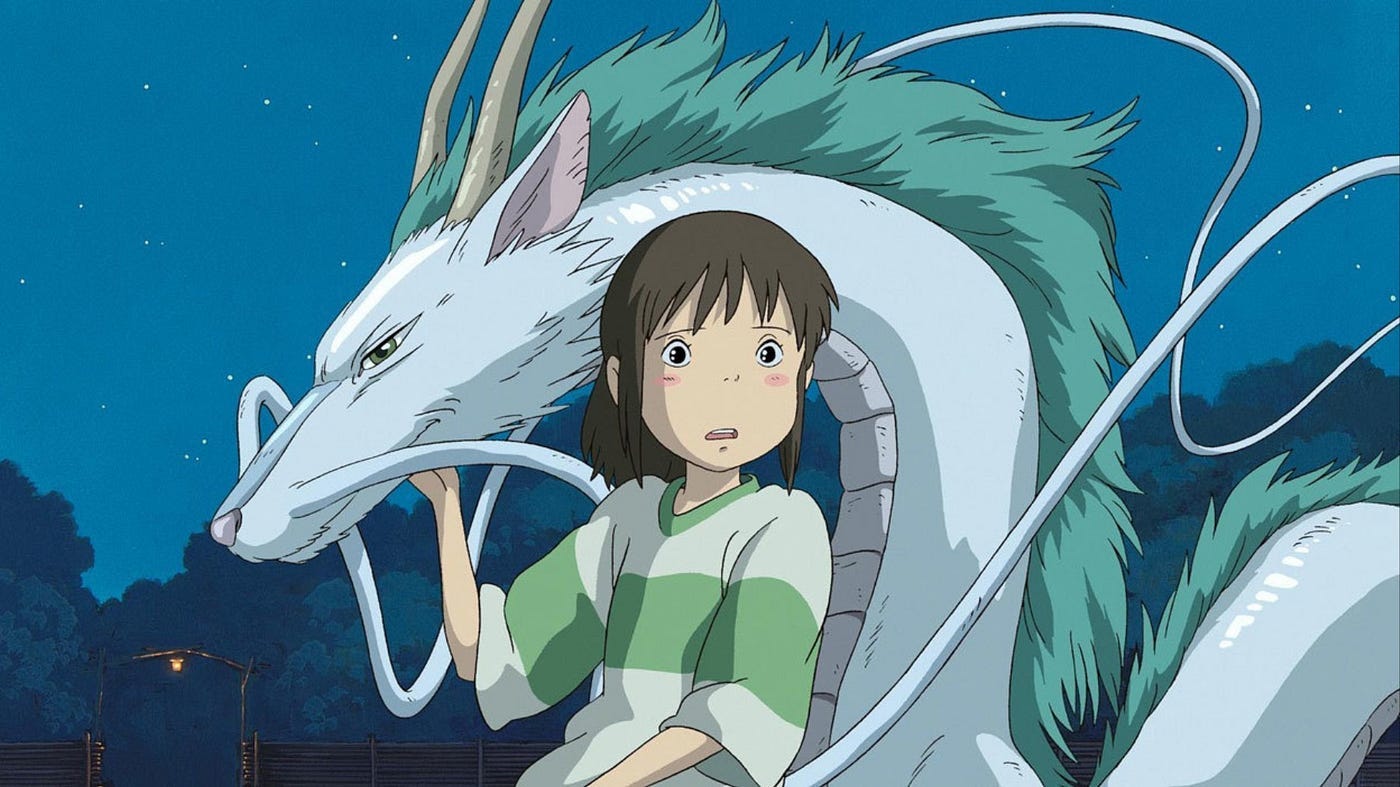
Ah, Studio Ghibli.
A polarizing subject.1 Not because anyone could argue against its artistry, oh no. And not because anyone could deny the indelible effect this studio has had on animation, on music, and on oh, maybe everything. I’ve given my pitches here before on Princess Mononoke and Howl’s Moving Castle, both movies I love dearly, but that’s because I didn’t yet feel ready to tackle what is the most well-known, the most influential, and frankly, objectively2, the best of them all.
Spirited Away is considered one of the greatest animated films ever made. In the bajillion (my conservative estimate) films made in the past century, this movie consistently floats to the top of “Best of” lists. It would not be an exaggeration to say that the film single-handedly raised the global standard of what animation was capable of. Bursting into the scene in 2001, the film found enormous success with Japanese audiences before Disney handled its North American distribution, where it exploded in popularity, snagging an Academy Award for Best Animated Feature along the way. Since then, echoes and encores on this film are everywhere. From Disney, to Pixar, to Marvel, and countless indie films in between, you’ll find Spirited Away cited as an influence. Artists of all kinds, from Steven Spielberg to Billie Eilish have praised Spirited Away as inspiration. It has remained firmly at the top, and its legacy is not budging anytime soon.
So what’s the deal?
Spirited Away starts with the simple setup of a family moving to a new place. Young girl Chihiro’s despondent attitude is clear from the beginning. As she clutches a bouquet of wilting flowers given as a parting gift, it is obvious that she is unhappy and angry with her parents, with her situation, and with herself.
One wrong turn later, the family finds themselves exploring a seemingly abandoned bunch of buildings, with an increasingly fretful Chihiro urging her parents to leave, a mysterious, freshly cooked feast entices her parents to stay.
Not to give too much away for those who haven’t had the pleasure, but suffice to say, Chihiro is going to find herself trapped in a dazzlingly colorful and busy Spirit World, where she must blend in, work hard, and try to save both herself and her hapless parents. In the course of the film, Chihiro, robbed of her name but now called Sen, is going to be the bravest she can be, all while her terror, loneliness, isolation, and growth are beautifully, delicately, and achingly portrayed.
Director Hayao Miyazaki is one of those people so inordinately skilled you can’t be quite sure they are real. His artistry is superhuman, and much as I want to go on, I need to leave it at that. One of his signature moves is his penchant for portraying the beauty of ordinary moments, such as tapping a shoe to get it to fit right, wringing a cloth, or folding blankets. The time and effort and love that he pours into hand-drawing these seemingly unnecessary actions humanizes the characters in a way that dialogue cannot. By including these ordinary moments in the extraordinary spirit world, he brings the two together in a way that grounds it. This is, first and foremost, a fairy tale. But he will dwell in these little moments, giving this fairy tale a depth, body, and substance that has always set his work apart and always will.
While she remains trapped in the Spirit World, Sen has to work in an enormous bath house. For a girl unused to such hard labor, she struggles mightily, falls frequently, and suffers the ridicule of the spirits who encounter her. But she perseveres. Miyazaki wanted to create a realistic heroine for young girls. She had to be scared, and then choose courage. Sen has to undergo a transformation from a slightly spoiled, self-centered, petulant child to a selfless, sacrificial hero. And she will work hard for that transformation. She will undergo many sufferings, she will be out of her mind with fear and fatigue, but you won’t catch her giving up. Of course, she won’t be alone. The Spirit World offers a plethora of side characters to delight, to scare, and to confuse. The creativity bursts from the seams of this film, and the fact that Miyazaki had to cut several scenes to keep the film to a reasonable length leaves me feeling cheated. What have we been deprived of?
The colors are rich, the visuals are outrageously gorgeous, and the warm color palette wraps around you like a hug. There is so much beauty to dwell on, but we must give laurels to what, to me, stands out the most in this film, and has stuck firmly in my mind since watching it for the first time at the tender age of 5, and that’s the music.
Spirited Away was the first film to teach me the power of a score. That music can swell the emotions of a scene to bursting, and remain with you long after the end credits are over. I will die on the hill that “One Summer Day” is the most emotionally cutting instrumental featured in a Ghibli film, and that the last minute of “Sixth Station” is unreasonably emotive and pianos shouldn’t be able to do that. There are no misses with this soundtrack. It dances between soothingly delicate and gloriously grand, with a cohesive intensity that connects the two in a way that shouldn’t make sense but it does.
Hyperbolic? Perhaps. But this film can’t be talked about in casual terms. I’ve never met a person who walked away from this film with a neutral opinion.
This is a movie that explores identity. Sen is robbed of hers in the spirit world, and must regain it. A secondary antagonist, fittingly named No-Face, is a spirit who has no identity, but subsists on absorbing the traits of those he consumes. He reflects Sen in that they are both blank slates
in the Spirit World, but while he is quickly corrupted by greed and selfishness, she is not, because she is sustained by love. Love for her parents, love for the friends who help her, and love even for her enemies. This love is going to help Sen remember that she is Chihiro, and Chihiro has grown into a far better version of herself, strengthened by the trials she has endured. Miyazaki is not Catholic, but he keeps accidentally making films with beautiful Catholic sensibilities. And we praise God for that.
Words fail, really. This is a movie to be experienced. Is it strange? Yep! All Ghibli movies are. Is it beautiful? Is it worth it? Is it thought-provoking? Is it exciting? Is it contemplative and complex, whilst also being simple enough to be understood by a child?
Yes. In a word, this film has gravitas.
There’s a Ghibli movie for every vibe, but if you want the quintessential one, the one that most completely represents the Platonic form of Ghibli movie, it’s this one. 25 years later, it’s still calling the shots.
It’s worth anyone’s time.
Spirited Away is available on HBO Max
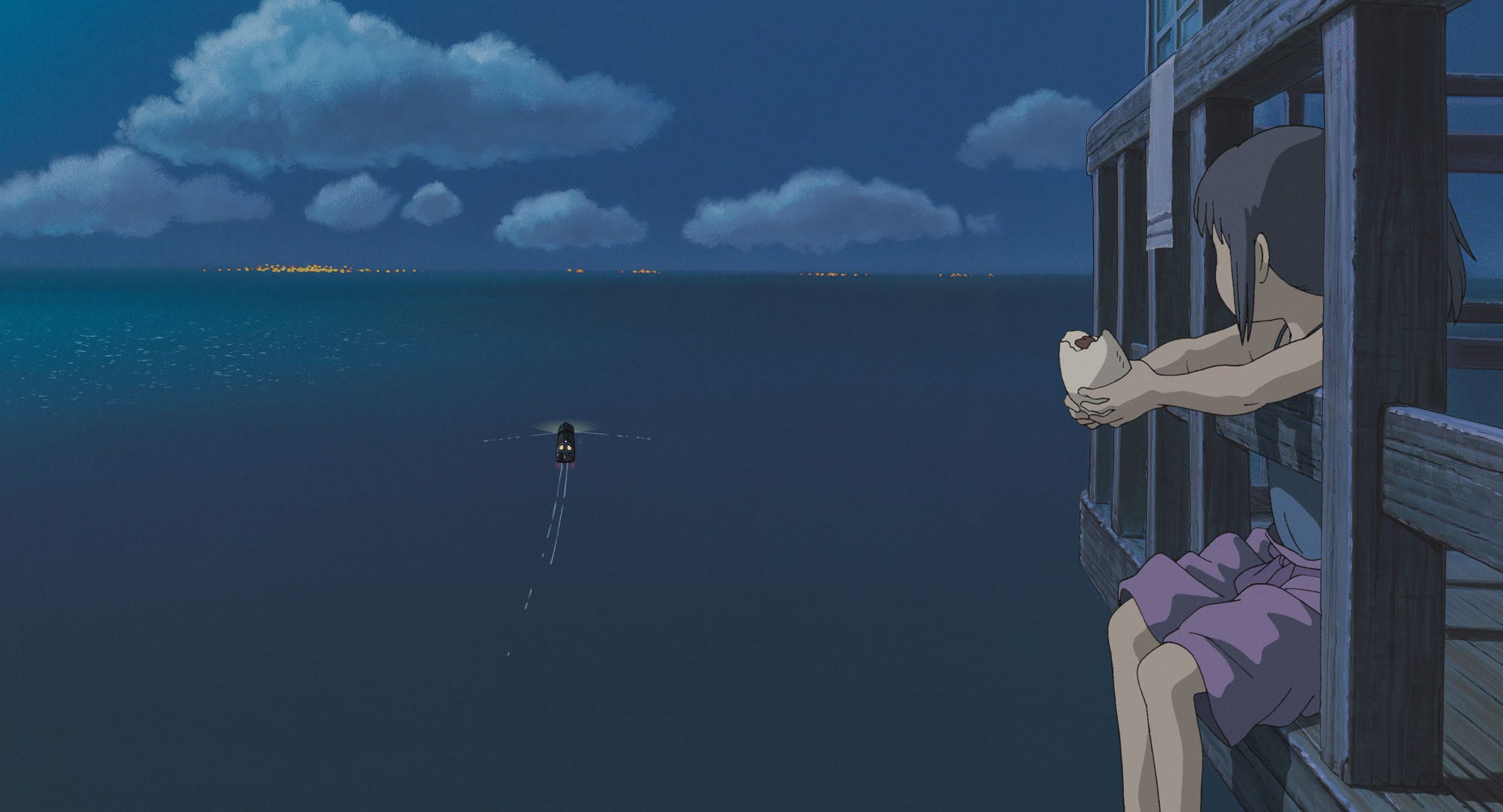
Why? Because frankly, some of them are a bit strange. Beautifully strange, whimsically strange, achingly heartbreakingly strange, but still strange. In the same breath that I will defend and promulgate Ghibli, I will concede this point. And not all Ghibli films (or Ghibli adjacent films) are created equal. You won’t catch me starting someone’s Ghibli journey with Pom Poko, or Tales from Earthsea. You definitely won’t catch me ANYWHERE near Grave of the Fireflies, which in my conservative opinion, is the most emotionally obliterating movie that's ever been made in the history of ever. This is not to dissuade anyone who is willing to test the limits of how much a movie can hurt them, I’m just weak and don’t like being made the SADDEST I'VE EVER BEEN.
I know there will be people who fight me on this one, have your people contact my people and we can duke it out.

I watched it once and I cried so much! The strength she had throughout.