


Na Hong-Jin’s fourth feature directorial effort and first in ten years may be the most perplexing film of the year.
As the credits rolled, I turned to my friend and remarked “I am not sure if that was good bad or bad good” only to find out that is Reactor Mag’s review title. Both 1/10 and 10/10 scores are understandable for Hope. It is the first and possibly the last film to play in competition at the Cannes Film Festival that sits at the exact nexus of Transformers: Revenge of the Fallen, Zack Snyder’s DC films, and Prometheus (complete with another freaky Michael Fassbender). And in today’s era of post-ironic, clinging facetiousness, it is almost impossible to determine where the joke begins and ends.
Saying almost anything about the plot of Hope would spoil all of it. Like my earlier comparison of Transformers: Revenge of the Fallen, Hope is largely noise.
Monsters are attacking the small South Korean village of Hope Harbor and the townsfolk have to mount a desperate effort to save what’s left. About two-thirds of the film’s gargantuan yet surprisingly weightless 156-minute runtime is dedicated to just two action setpieces. Characters are only really texture to the soundwaves, but if there is one thing this movie has, it is texture. For a film with absolutely no character arcs, there are a lot of memorable characters: grannies who appear to reactivate like sleeper agents from the 6-25 Upheaval (Korean War), a weirdo who might secretly be a serial killer, and yep an unrecognizable Michael Fassbender to name just a few. As a sidenote on the film’s top-billed Western cast members, I am not entirely sure some of them have a single line of dialogue.
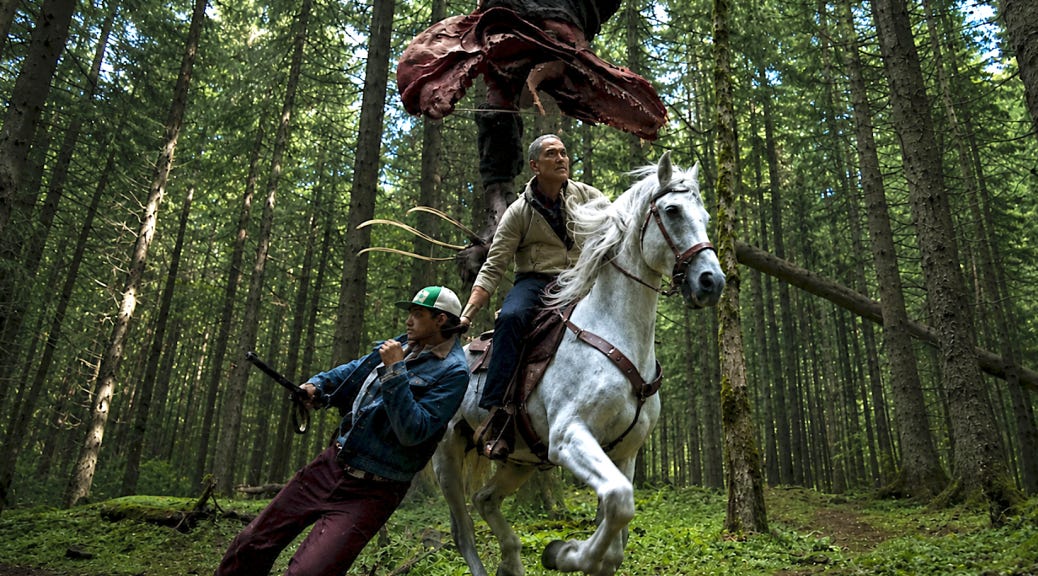
The two aforementioned action setpieces are thrilling and make the runtime seem far shorter. There are multiple chases – in or on foot, bicycle, horse, and car. Squid Game breakout Hoyeon plays a small-town cop with proficiency in machine gun grenade launcher attachments– of course during a car chase. If you enjoyed the opening scenes of Batman v Superman or A Quiet Place: Part Two, there is over an hour of that kind of human dwarfing, hi-fi Cloverfield destruction. About thirty or forty minutes in, though, we get the reveal of the monster, whose CGI looks so bad that it might be a gag. We are talking slightly above the level of that Chinese animated movie made by a mother and son for $200. The idea that everything is all one elaborate joke is slightly more believable in the same movie where an extended monologue about explosive diarrhea is the best scene.
What the director is trying to convey is equally vexing. In a slightly spoiler-y quote (skip this paragraph and the next if you want to avoid) Na Hong-Jin said to the Korea Times that “I wanted to depict human affairs from the perspective of a god. But putting an actual god in the film seemed awkward, so I turned the figure into an alien”. However, Hope ends exactly when we start to understand the monsters’ purpose and what the film might be trying to say. Allegedly, this is supposed to be the first in a trilogy, but this film is intended to stand on its own. Yet there is something here about the relative insignificance of human drama and society in the face of divine or cosmic drama. The DNA of Prometheus (2011) and Man of Steel (2013) are palpable here.
The first act is peppered with references to North Korean spy paranoia and immigration which made me think we were going to get more commentary around those topics: the Korean divide, refugees, xenophobia, and so on. Again, there may be something said there, but the film never gets to any sort of resolution. The monsters might be misunderstood refugees that instantly receive aggression without any questions asked. At the same time, characters like Hoyeon’s express a rage at the brutal indifference and injustice of the monsters’ attack. Or the monsters are essentially deities whose struggle makes the humans insignificant because they were never remotely on the same playing field and the human response is representative of struggle in the face of natural/economic/transcendent disaster. What are we supposed to take away here? But unlike Batman v Superman or Alien: Covenant, this is all only hinted at. There is not enough to be provocative positively or negatively.
Hope might be a serious attempt at a franchise starter or a cheeky anti-blockbuster that purposely builds you up just to let you down. It is probably both and either way, you are the joke. Almost two decades of self-injuriously self-aware, big budget filmmaking probably culminating in Deadpool & Wolverine has made the difference between the two unclear. 2026 feels like a year, though, where we might be finally moving on from the 2010s model with sincere pictures like Backrooms and The Odyssey making more money than the latest cynical, actually bad pretending to be performatively bad takes on Star Wars, the DC universe, and Masters of the Universe.
As harsh as the preceding paragraph sounds, it might be surprising that I would recommend it to some audiences. The action, even with the terrible digital effects, is great, mainly because everything besides the monsters is joyously tactile and practical. Suspension of disbelief is stretched thin, especially when it comes to the durability of a jean jacket, but even that becomes an entertaining gag in its own right. Stay for a mid-credit scene on that one. The quirky cast of characters are funny and give you just enough attachment to favor them over the monsters. Perhaps the film being non-Western makes the formula cut further from the bone or that my reaction to it was thrillingly puzzled exasperation rather than the usual numbing indifference, but I enjoyed Na Hong-jin’s messy epic far more often than I did not.
Hope is now playing in theaters.
