


(Mild spoilers follow)
Following the resounding success of Godzilla Minus One, Takashi Yamazaki had the near-impossible task of following it up with a sequel. Minus One is probably the greatest Godzilla film of all time, with a human aspect comparable to a quality war drama film. While Minus Zero doesn't quite reach the human-drama highs of its predecessor, it matches or surpasses it in almost every other metric while maintaining profound messages.
Yamazaki made this film in response to Christopher Nolan’s dark but fantastic Oppenheimer. That film explored the act of letting the metaphorical “genie” out of the bottle and living with the consequences. Minus Zero, on the other hand, challenges the audience to put it back. One of the characters is haunted by a bone-chilling memory of the Hiroshima bombing that is perhaps the most disturbing nuclear scene since Terminator 2. When confronted with the potential creation of a new superweapon, he is told by one of the crucial characters in the film, “It has to end with us”. The film begs us to be the ones to stop destruction, war, and the continual escalation of weapons. Eventually, someone has to step up and say “no”.
The importance of the family is another major point that is stressed to tear-jerking ends. The effects that war and disasters can have on families are undeniable, but all members are crucial and remarkably resilient. Therefore, it must be protected at all costs and never sacrificed for one’s own selfish desires. I won’t dare discuss this point anymore for the sake of avoiding spoilers, but I assure you that this is a deeply “pro-family” film.
Trauma is further explored in Minus Zero, but takes a different route. While the first installment discusses it in general terms (with great effect), here we are warned about letting our trauma turn us into something we are not. If great evil is done to us, we must not let it inspire us to perpetuate evil. Again, we must be the ones to break the cycle so we as a species can begin to heal. We must also not let it get in the way of moving forward and being able to help others (a continuation of Minus One).
With that being said, perhaps the only flaw with the film is its balance. It wants to convey such deep themes and give every character a profound aspect to add to the conversation that it gets a little lost in finding how to juggle it all. It feels a little unstructured, lacking the clear vision and narrative of its predecessor. By the second act, it finds its stride and never looks back, but it does sort of get lost in itself trying to find the best method of conveying what it has to say. I was also a bit perplexed at a few decisions by characters made in the moment. Most are explained or make sense later, but nevertheless did take me out of the moment temporarily.
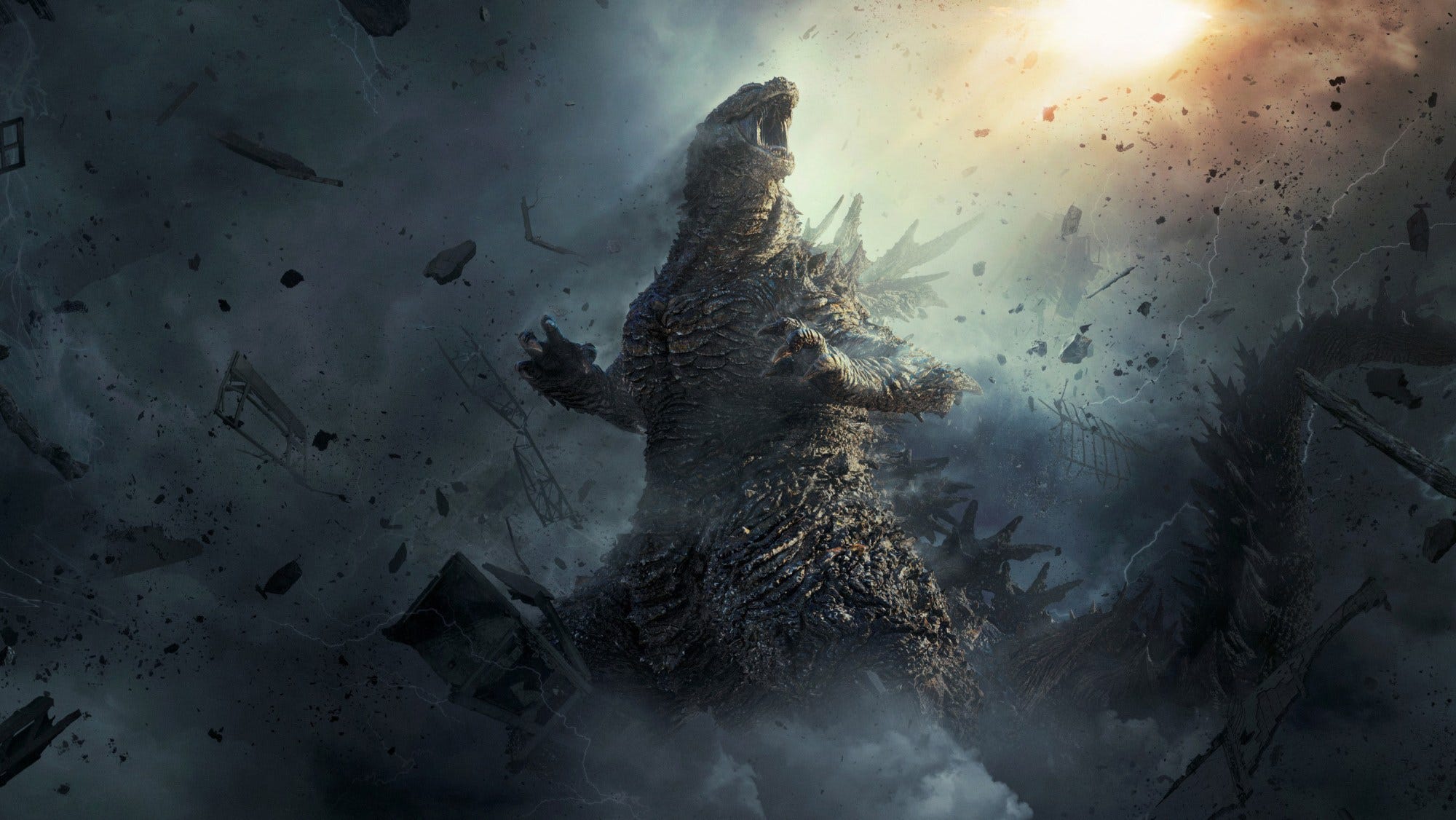
This slight deficit in narrative cleanliness is countered by the most awe-inspiring and epic spectacle of 2026. For a mere $15 million, Godzilla Minus Zero puts on the greatest monster footage ever caught on camera, and boy, is it LOUD. Every smash, bite, death ray, and collapsing building feels like you are a spectator trapped in the rubble watching the largest characters ever cause as much carnage as possible. Blood and some gore can be seen in brutal fights, paired with an impeccable score that masterfully upscales an already titanic battle so loud that it is setting off people's smartwatches, warning them that they are in too loud an environment.
Somehow every VFX shot looks like it was made with an absurd budget, and every minute that passes continues to reaffirm the sentiment that Hollywood productions are now excessively bloated. A key detail that helps amplify the scale is in the movement of the Kaiju. They do not move like relatively normal-sized beings, but slow and highly momentum-based. Compared to their movement of Godzilla: King of Monsters, these Kaiju look like they are moving through molasses (as they should).
The performances are all solid and add a layer of seriousness to it that frankly works for me. I’m willing to buy into a more serious Godzilla world since it has demonstrated competency in both films with the human drama elements and the themes. Yamazaki’s commitment to a relatively time-period-accurate and historical universe that gets at the root of what Godzilla really is is frankly a breath of fresh air. The affinity for historical aircraft is also not lost, as I am not sure who the plane nerd on the crew is, but their expertise is definitely noted. Costumes and set design manage to help submerge us in a Japan that truly feels like it is struggling to pull itself out of the ashes of war.
In the end, this serious monster mash spectacle does get a little lost in the human aspect, but ultimately sticks the landing for the grandest spectacle of 2026. For a tenth of its American counterpart’s budget, it manages to have far more to say and look more convincing. Whether or not Takashi Yamazaki makes a third installment, he has certainly left an impact on the world of Godzilla with two of its greatest installments. I am thoroughly excited to watch it again and to watch whatever project he may choose next.
