


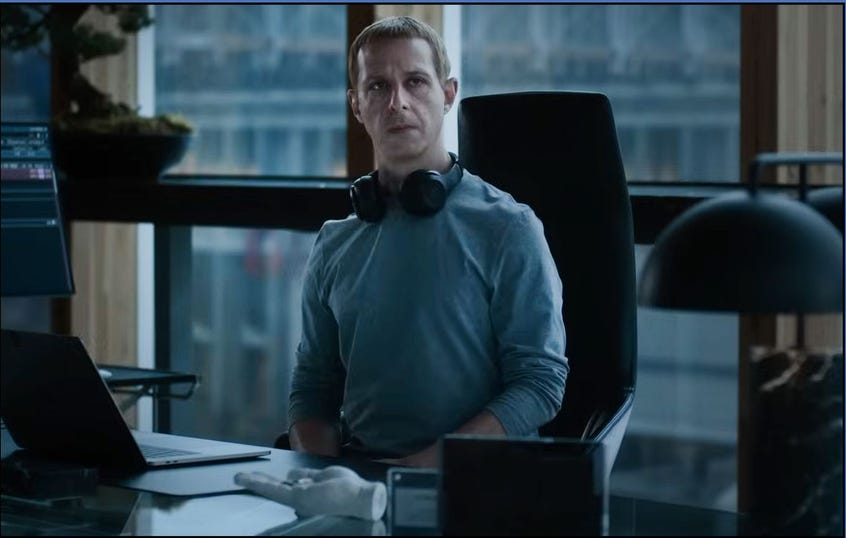
The Social Reckoning is Aaron Sorkin’s newest dissection of Mark Zuckerberg and Facebook. While this film still follows Facebook and features Zuckerberg, it is not a true sequel to Sorkin’s 2010 film, The Social Network (dir. David Fincher). It doesn’t follow up on the events where The Social Network ends, or seemingly want to connect itself to The Social Network despite the two films having the same writer, topic, and character. Instead, Reckoning is concerned with telling an entirely different story by focusing on the Facebook Files - a series of articles published in The Wall Street Journal discussing Facebook’s internal documents which showcased the platform’s negative impacts on society. Thus, instead of building on The Social Network, Reckoning solely focuses on how the Facebook Files came to be.
As Reckoning progresses, it develops an overarching thesis: should free speech on social media be absolute, or, should posts be regulated and should platforms establish rules to regulate what individuals can and cannot post. The film follows these issues through two different groups: Mark Zuckerberg (Jeremy Strong) who advocates for the absolutist position and Jeff Horwitz (Jeremy Allen White) and Francis Haugan (Mikey Madison) who want to expose Facebook in order to have the company enforce greater relegation over its platform. Horwitz and Haugan argue that unchecked algorithms can film influence and “radicalize” individuals; hence, the need for regulation. In contrast, Zuckerberg argues that he is a free speech advocate and refuses to place any restrictions on what can be posted to Facebook. Reckoning is extremely thought-provoking as each side debates its case over the course of its runtime.
Unfortunately, this is the only good aspect of the film.
While I enjoy this movie debating its theme of regulation, I really dislike that the film triumphs one case over the other. Sadly, Reckoning is not open ended nor does it respect the audience to formulate their own conclusion. Without spoiling the film, it openly mocks the audience and forces its belief on the issue of regulation. It doubles down on its position to the point where it illogically arrives at a conclusion that is completely out of context, unnecessary, and utterly absurd. Instead of the ending being a battlefield where both sides, pro-absolutist vs. pro-regulation, meet in an exhilarating crescendo, the ending was merely an upset writer (Sorkin) screaming into the void while simultaneously patting himself on the back.
One question that I wish Reckoning focused on is should someone have complete control over who is able to post on social media platforms or should there be a governing body that promulgates what can be posted. The film focuses on algorithms and how algorithms can influence and “radicalize” individuals, but doesn’t focus on the absolute power that an individual like Mark Zuckerberg has. Should he be the person who regulates everything on his platform? Should world governments have the ability to deny or approve what can and cannot be posted on these sites? Should these decisions be left up to the corporations themselves? Unfortunately, the film completely removes this question, and, once again, tells the audience how it should think and provides the answer for it.
To pile on, the editing is absolutely abhorrent in Reckoning. Shots lingered too long and sequences didn’t line up as the plot transitioned from following Horwitz and Haugan to following Zuckerberg. There are shots within scenes that didn’t make sense. For instance, one scene where characters sat around a table opened with a shot of all of them, then transitioned to focus on a person talking which switched to someone who wasn’t talking and had no visible reaction to what was being discussed. Then, it cut back to a wide view of everyone in the meeting room and you couldn’t tell who was carrying the conversation. It was jarring and pointless. Needless to say, I have seen shorts that have better editing than this sequence.
I would have liked to see Jesse Eisenberg reprise his role as Mark Zuckerberg. He really carries The Social Network and I think he would have added to this film. Unfortunately, Jeremy Strong delivers the worst performance of his career and acts like a plank of wood for every appearance on-screen. Additionally, having continuity with The Social Network would have strengthened this film and Eisenberg would have had a stronger on-screen presence.
If you are someone who is interested in these types of social questions and debates, I believe you should go see this film. While I do not agree with Reckoning’s conclusion, I do not think that my opinion should dissuade one from seeing it.
“What is this, some kinda ‘Social Reckoning?’”