


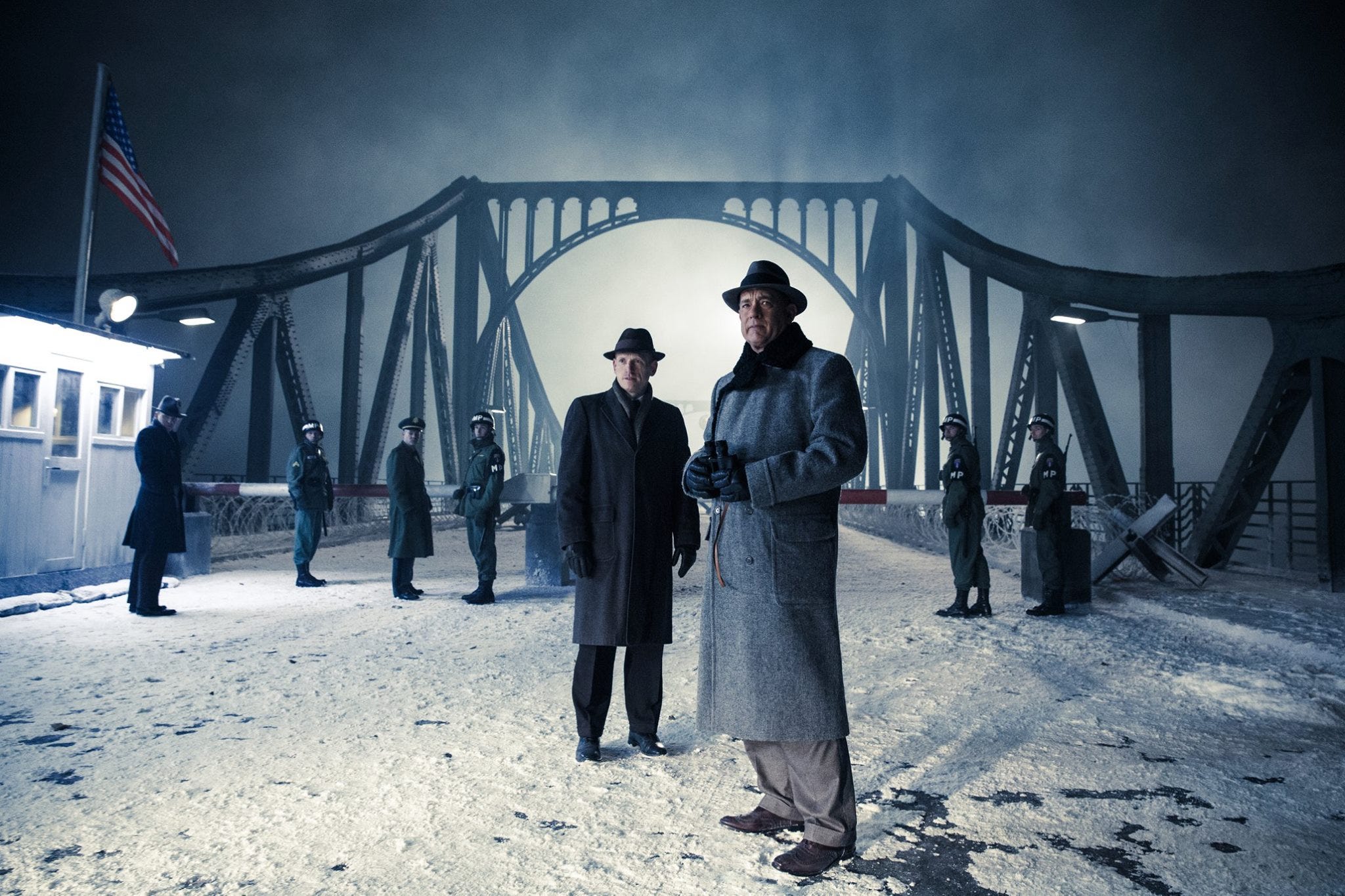
What do you get when one of the greatest directors of all time works with some of the greatest screenwriters (and directors) of all time?
You get 2015’s Bridge of Spies, directed by Steven Spielberg, written by the Coen Brothers, and starring both Tom Hanks as the real life diplomatic negotiator James B. Donovan and Mark Rylance as the Soviet spy Rudolf Abel.
Spielberg loves a good rescue movie- Saving Private Ryan, Empire of the Sun, and even The Lost World: Jurassic Park all revolve around the eventual rescue of their protagonists from life-threatening circumstances. To quote New Yorker critic Richard Brody in his review of this film:
Spielberg has always been obsessed with the ideal of rescue, with the mobilization of a mighty system designed for other purposes, whether war or business, for a humanitarian mission in the interest of a single person in dire straits. That ironic shift, for Spielberg, is a matter of passionate empathetic devotion; it could as easily reveal the absurdities and paradoxes of the system, which is why the Coen brothers’ collaboration on the script makes surprising sense.
In Saving Private Ryan, a squad of soldiers (led by Tom Hanks’ Captain Miller) deployed for killing must brave everything for the saving of a life rather than destruction. Even in Jurassic Park, the heroes are rescued by the very thing that tried (succeeding at one point) to eat them, when the T-Rex chomps up the Velociraptors via dinosaur ex machina.
There’s a touch of the providential here, with the bravest and most heroic deeds stemming from the least ideal circumstances. As alluded to by Brody above, this is why the Coen Brothers were the perfect choice to write this story. Many of their films, from Fargo to The Big Lebowski, from No Country for Old Men to A Serious Man, have to do with fate and the inexplicable, often unseen hand that affects our daily lives, sometimes in major ways.
James B. Donovan- like most Spielbergian protagonists- is painted here as the quintessential American man: hence the casting of Hanks. This marked Spielberg’s fourth collaboration with his close friend, and right after this film they made The Post together. Hanks, for many Americans, embodied that same position that Jimmy Stewart did for a while as a trusted presence on the screen representing the common man.1 However, the introduction of Donovan shows that he is an insurance lawyer, hardly anyone’s idea of a “white knight”, and the film opens with him representing his company against five injured drivers.
Where Donovan’s moral center comes in- gradually- is when he is assigned to represent Rudolf Abel (Rylance), a quiet, unassuming old Russian who turns out to be a Soviet spy. Donovan spends a lot of time with Abel, who is remarkably calm and unbothered throughout the proceedings which may result in the death penalty: his response to Donovan over and over when the lawyer remarks that he should be more worried is “Would it help?”
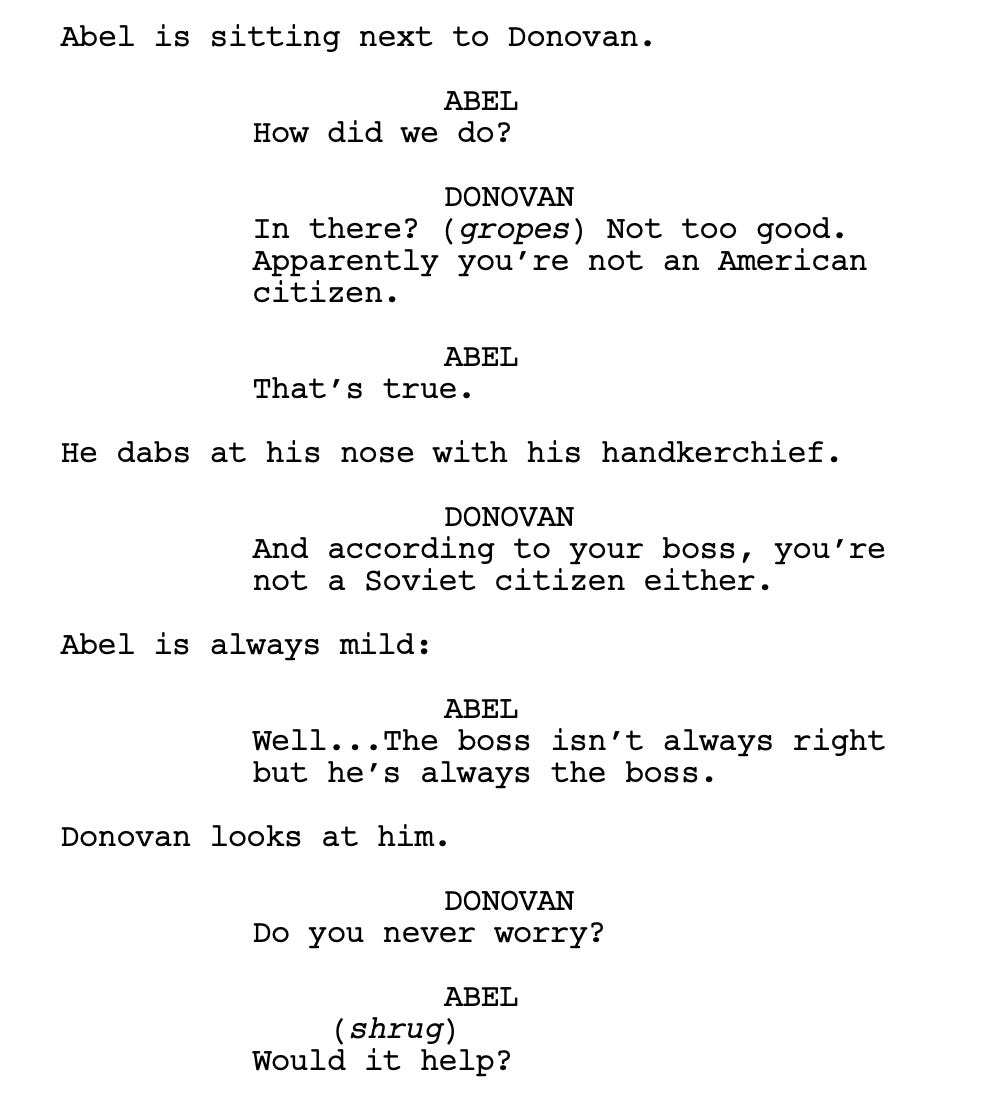
As the situation evolves to the point where Donovan must travel into the Soviet Union to bring Abel for a prisoner swap, Hanks’ lawyer ends up becoming more and more impressed with Abel, who seems to be a good man who has been abandoned by his own government. An impassioned letter from Abel’s wife thanking Donovan for his work in keeping her husband safe only motivates him further in helping him to get home.
This does not sway Donovan from his homeland nor is this some secret anti-patriotic propaganda: much like The Hunt for Red October this film shows that there are heroes and villains on both sides. Both the US and USSR are so stifled with bureaucracy that any intent of good from anyone involved will get lost and pushed aside. It takes people like Donovan who go the extra mile, making the sacrifices necessary to do the right thing and preserve the virtue of their nation.
From a filmmaking perspective, let there be no one who says that all late Spielberg is trash and not worth watching: he’s still working at his best in this one. The tension throughout the film and the comedy provided by the Coens shines through Spielberg’s lens, and the scene where the U2 pilot is shot down and a perilous crossing of the Berlin Wall are both fantastic action sequences. Hanks and Rylance make a perfect odd couple, supported by reliable actors Scott Shepherd and Amy Ryan, to name a few. This also is the rare Spielberg film that is not scored by John Williams, with Thomas Newman providing an excellently subtle score (Williams at the time was caught up with Star Wars).
Overall, Bridge of Spies is a highly rewatchable film that is one of the best of the 2010s, and a hopeful note to round out this list of political thrillers.
Some argue that Matt Damon now occupies this space