


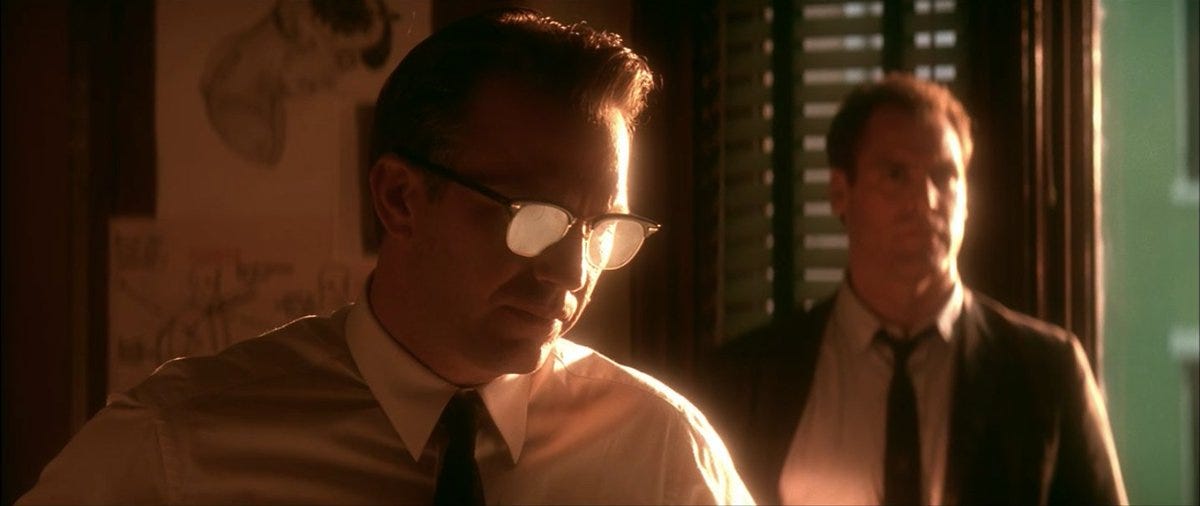
Oliver Stone, coming off the successes of Platoon, Wall Street and Born on the Fourth of July wrote and directed JFK. Upon its release it was controversial for reasons that shall be explained, but for thematic reasons does well at answering the question: what exactly had America become post-World War II?
Despite its title, the film is not about the president who was famously assassinated in 1963. The movie itself is about the curious circumstances surrounding his death and the one man, Jim Garrison (Kevin Costner), trying to prove that the circumstances were, in fact, peculiar.
The tone and tenor of the film are established within the first ten minutes beginning with a replaying of Eisenhower’s address to the nation upon his departure from the Office of the President. Famously in this speech, Eisenhower, warned the American people of a managerial, industrial apparatus with the sole purpose of creating weapons so powerful we can destroy ourselves with them; “The Military-Industrial Complex,” as it was termed by Eisenhower.
Kennedy was consistent in his opposition to this apparatus in public and private. Kennedy, in public addresses, had indicated a new tone for the country, a less apocalyptic tone, especially after his Cuban missile standoff with the Soviet Union. Kennedy had understood that the only reason such a situation could have ever occurred was because the United States (and the Soviet Union) had an entire class racing to a literal finish line: what Wendell Berry had termed, “the world-ending fire.”
Kennedy’s rejection of this apparatus, complex and class earned him a suspect reputation among the military-intelligence power brokers in Washington and viewed him as soft on the Soviet Union. Throughout this part of the film, Kennedy is delivering an address, likely to a college, rejecting this mentality and honing in on a vision oriented toward posterity, our own human mortality and children. The film cuts shortly after this to footage from the Zapruder tape and news coverage after Kennedy’s assassination. Immediately, Jim Garrison, a district attorney in New Orleans, and his office get to work as Lee Harvey Oswald, Kennedy’s assassin, was from New Orleans. The only lead his office and the FBI had turned out to be a dead end. By this point, Lyndon Johnson had begun further planning for the war in Vietnam, the conflict that became emblematic of the military-industrial apparatus.
Everyone up to this point in the film, expresses their doubts around the curious circumstances of John Kennedy’s assasination, Garrison included. Garrison chats it with a liquored-up Senator (Walter Matthau); he exclaims: “One pristine bullet, that dog don’t hunt!” He is commenting on the validity of the Warren Commission, the committee formed to investigate the Kennedy Assassination. Upon hearing this Garrison begins to find inconsistencies and illegalities within the report.
Garrison, for most of the film, is piecing and weaving together different threads of the events, the circumstances and possibly a case so as to bring to trial men he thinks are partially responsible for the assassination of Kennedy. As he is piecing everything together, many potential witnesses refuse to testify or die under suspect circumstances. But the most important scene of the film, narratively and thematically is the conversation between Jim Garrison and Mr. X (Donald Sutherland), which occurs roughly two thirds into the film. The conversation details the extremely suspicious activities of the military-industrial-intelligence apparatus in the weeks and days leading up to the Kennedy Assassination.
In the aftermath of the Second World War and beyond, the intelligence wing of the American government had funded a number of operations that sought to contain communism at home and abroad. This came to be known as Black Ops. This is how Mr. X describes the pre and post-Kennedy assassination activities of the military bureaucracy, with the killing itself being one of them.
On the surface, one can accede to the position that the Kennedy assassination was a black operation. But much deeper than this and what this scene is emblematic of is the final entrenchment of a technological, managerial and bureaucratic system that had been built and has persisted into the 21st century. Its only purpose is to function according to the law of production, so long as the product is clean the people will be happy. As Donald Sutherland’s character aptly notes the “most basic organizing principle for any society, Mr Garrison, is war.”
War in this sense is closer to what we would call annihilation. Annihilation, namely, of your opponent. Kennedy’s assassination is this principle internally applied. The precise destruction of one’s enemy can only be the industrial production of weapons or the effect of industrial production upon weaponry. That Kennedy posed such a threat to the dismantling of this apparatus is why he had to go, is the logic the managerial state will use as a last defense.
Such a system should be at any degree, be inimical to any self-understanding catholic politics. Any historically aware catholic political thought will know that the Church is the inheritor and executor of the Roman political and juridical legacy, which is concerned primarily with virtue. The Church is above all, also, concerned with the harmonization among opposites and difference but the Roman Empire, the Church and later the Holy Roman Empire would settle these things concretely and justly without the total annihilation of their enemies.
To conclude, what Catholics can take from this film, is not necessarily fear but the distinct possibility that this how government functions, not according to laws but according to the cold logic of destruction.
