


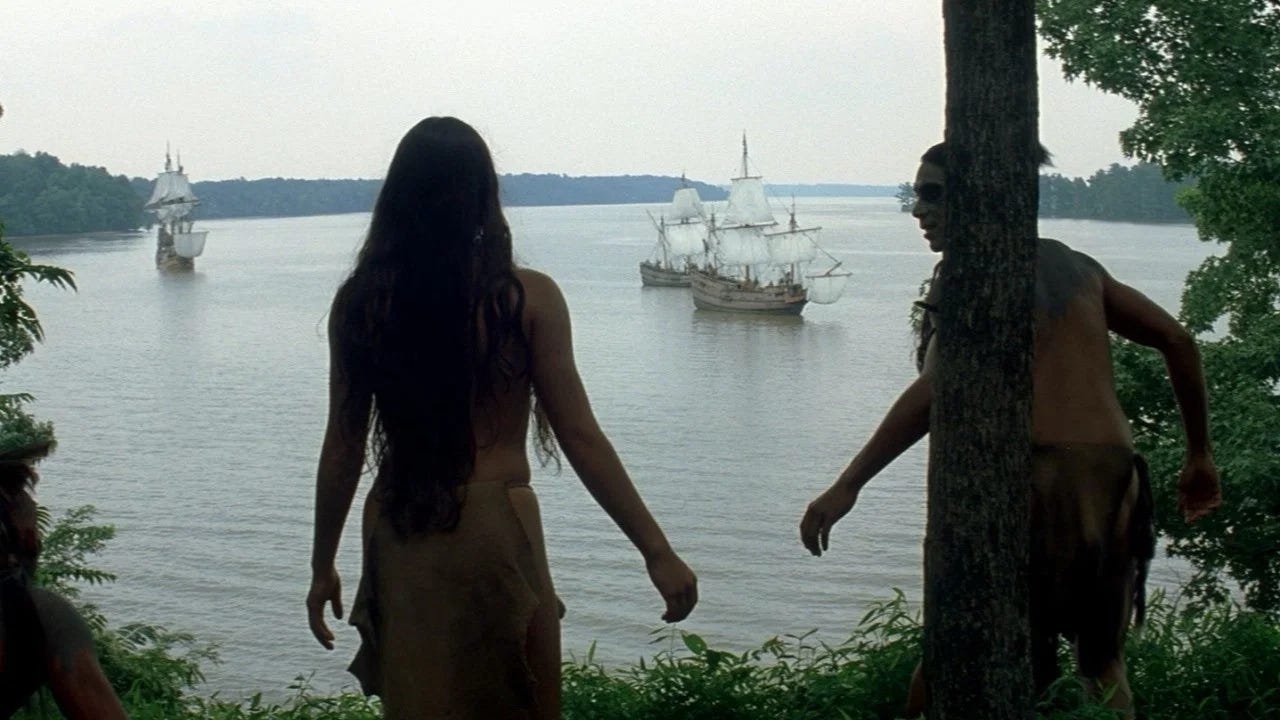
The New World is a work of quiet, aching beauty. Imbued with a sense of melancholy and reverence, it is often overlooked amidst a filmography that has produced the likes of The Tree of Life and A Hidden Life. Uncompromising in his artistic vision, Malick’s film proved hard for many to absorb, with its meandering narrative, frequent voiceovers, and highly picturesque rendering of the events surrounding the founding of the Jamestown Colony. Malick’s aesthetics are certainly polarizing throughout his body of work, perhaps because they demand something of the viewer. Art is not meant to be passive, and Malick’s films, more than most others, demand a response, an immersion, and most of all, a slowing down. Within this framework, The New World offers a work of remarkable philosophical depth, celebrating the beauty of God’s creation and the inherent dignity of mankind while meditating on encounter, the loss of innocence, and the search for identity.
Taking place in early Colonial America, The New World situates itself as an origin story, both in national terms and in terms of human transformation. The opening sequence is a jaw-dropping affair, depicting the viewpoint of the Powhatan natives as they see the white sails of the English ships entering their waters for the first time. Ever known for his exquisite taste in music, Malick sets the scene to Wagner’s Prelude to Das Rheingold, a shimmering piece that Wagner used to build a sense of space and wonder of creation for the Rhine River. This is an apt thematic choice, for not only does Malick’s film capture this wonder, but much of it revolves around a sense of mystery and anticipation as the two cultures collide.
What The New World does particularly well is balance a sense of grounded historical realism with Malick’s high artistry. The panning woodland shots with sunlight bursting through the trees never seem to detract from the sense of place that the film establishes. Few films have sought to bring the early colonial age to life, and fewer still have managed to do so with any degree of historical accuracy. From a linguistic perspective, the extinct language of the Powhatan tribe (a derivative of Virginian Algonquian) was painstakingly reconstructed so that the natives could speak it onscreen. Similar to Mel Gibson’s The Passion of the Christ and Apocalypto, this commitment to historical immersion pays dividends, adding an extra layer of authenticity. For the sets and locations, the production team consulted Jamestown archaeologists to construct realistic Powhatan housing and early colonial structures. However, Malick chose to stray from the hard facts of history for the emotional and thematic core of the film: the romance of John Smith and Pocahontas. Many historians have concluded that there was no actual love affair between Smith and Pocahontas; rather, it was a legend that has been romanticized and passed down through history in many artistic renditions. It is a legend, however, that served as the perfect vehicle for Malick’s thematic and aesthetic exploration.
The New World also marked the first collaboration between Malick and legendary cinematographer Emmanuel Lubezki, an artistic partnership that would go on to bear great fruit. Lubezki’s naturalistic visual style proved perfectly suited to the director’s poetic aesthetic. Shooting entirely in natural light, he was able to tap into a sense of the primal sacred. Removed from the artificiality of studio lighting, he gave the landscapes room to breathe and to evoke a sense of awe and wonder. This sense of beauty is a distinguishing characteristic of his work, yet many of Malick’s detractors like to dismiss his films as “too pretty.” Critic Tom Gunning argues in the Criterion edition liner notes for the film that “admittedly, [Malick’s] often breathtaking images may conceal the radical nature of his filmmaking, since in the modern era, serious art often prefers the discordant or the everyday, and avoids the comfort that ‘lovely images’ seem to offer. But rather than reassuring, Malick’s images inspire the awe associated with the sublime.”1 This speaks to the core of Malick’s vision. His images are not beautiful merely for their own sake; countless films are visually attractive. Malick’s beauty leads one beyond the surface to an encounter with the divine.
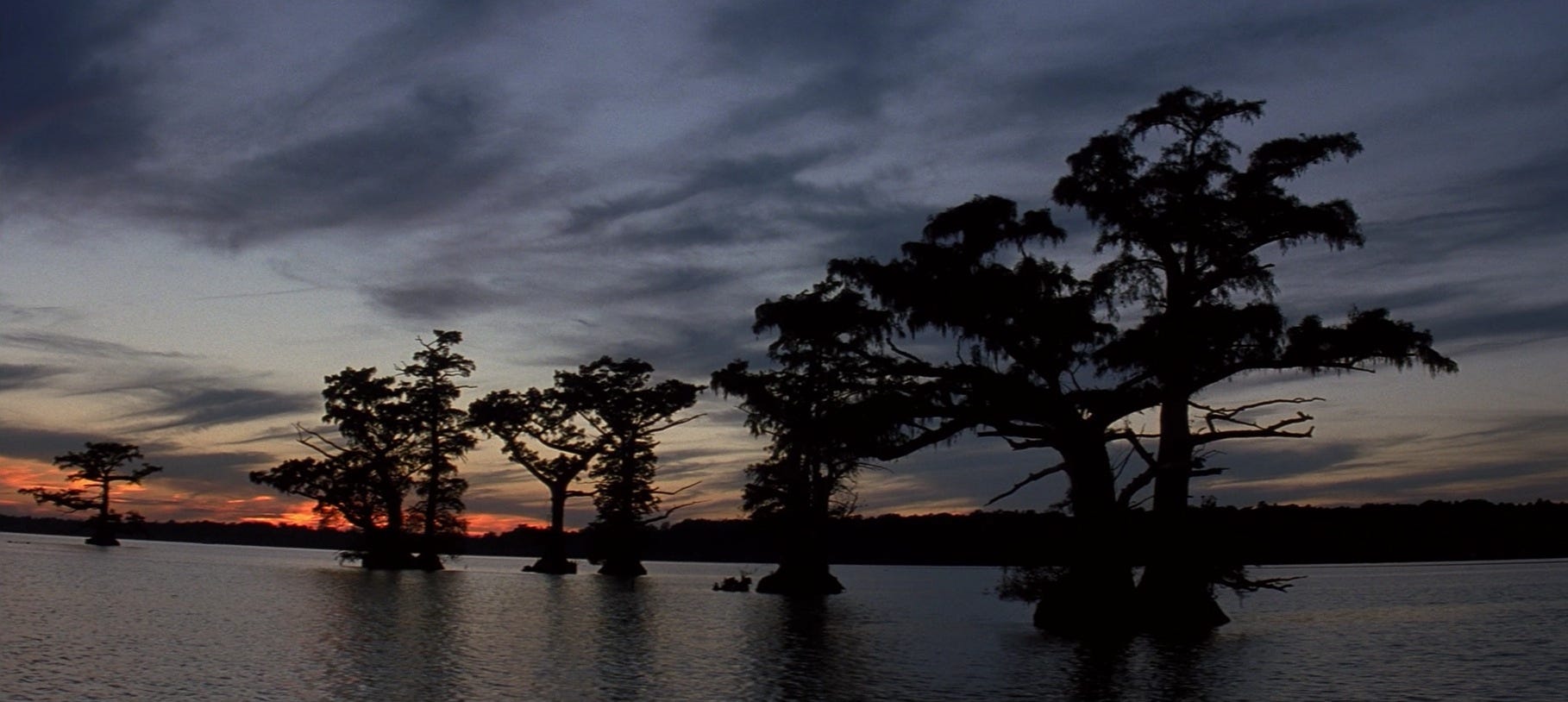
As with many of his films, Malick looks extensively to Sacred Scripture for inspiration. The New World nods to Genesis with Edenic imagery. In one sense, the pure, untouched natural vistas of the New World are a kind of Eden: unblemished and inherently good. The whole film can be read as a kind of Genesis story, as man goes from a state of natural innocence to one burdened by original sin. Malick is careful not to lean into a simplistic dichotomy by depicting the English settlers as inherently evil while exalting the natives as idealized noble savages. But he does use the contact and assimilation of the native tribes as a metaphor for the loss of original innocence. It’s a film about encounters and about identities. Both cultures are forced to encounter the other and to learn to understand their ways and, in a sense, lose their innocence. Nowhere is this more apparent than in Pocahontas and John Smith.
The film’s narrative largely centers around Pocahontas (played masterfully by Q’orianka Kilcher), following her journey from a young native girl prancing about the meadows to a fully Anglicized married woman walking gracefully through the English throne room. Malick utilizes parallels with the Book of Ruth, which centers on the theme of an outsider moving inward to find a sense of belonging while also experiencing a sense of loss for the identity left behind. Ruth is a Moabite woman, part of a nation completely foreign to Israel (and viewed with some hostility). She marries an Israelite. When he dies, faced with the decision to return to her Moabite people or remain with Israel, she proclaims:
Do not urge me to leave you or to turn back from you. Where you go I will go, and where you stay I will stay. Your people will be my people and your God my God. Where you die I will die, and there I will be buried.” (Ruth 1:16–17)
This very much echoes Pocahontas’s journey, as she eventually assimilates into the English settlement and begins an edifying marriage with Englishman John Rolfe. Malick never shies away from the pain of loss Pocahontas feels when leaving her way of life, nor does he minimize the pain that the native peoples felt as they lost their homeland. However, it is Pocahontas’s transformation, embrace of, and adaptation to her new way of life that make for the film’s dynamism. She approaches everything with a sense of wonder and respect. When she arrives in England, she marvels at the architectural wonders and the fine dresses. She gives birth to an English son and loves him dearly. There is indeed sadness for what was left behind and a recognition that it was good, but in The New World, Malick is able to articulate this fundamental notion of change, a notion to which many parallels can be drawn. From the Catholic perspective, there is the notion of God’s call in the life of vocation, which invites one to a life of transformation, to leave good things behind, but ultimately to choose a new identity in Christ. Pocahontas’s story remains the core of the film and something that elevates an aesthetically beautiful experience to the universal.
While Malick has created many masterful films, The New World deserves a moment of appreciation. It is a truly beautiful film and makes for an edifying and meditative watch. Watching the director’s cut is the way to go, as that most closely aligns with Malick’s vision. A Malick is a rich experience, it will demand a response, an immersion, and most of all, a slowing down.