


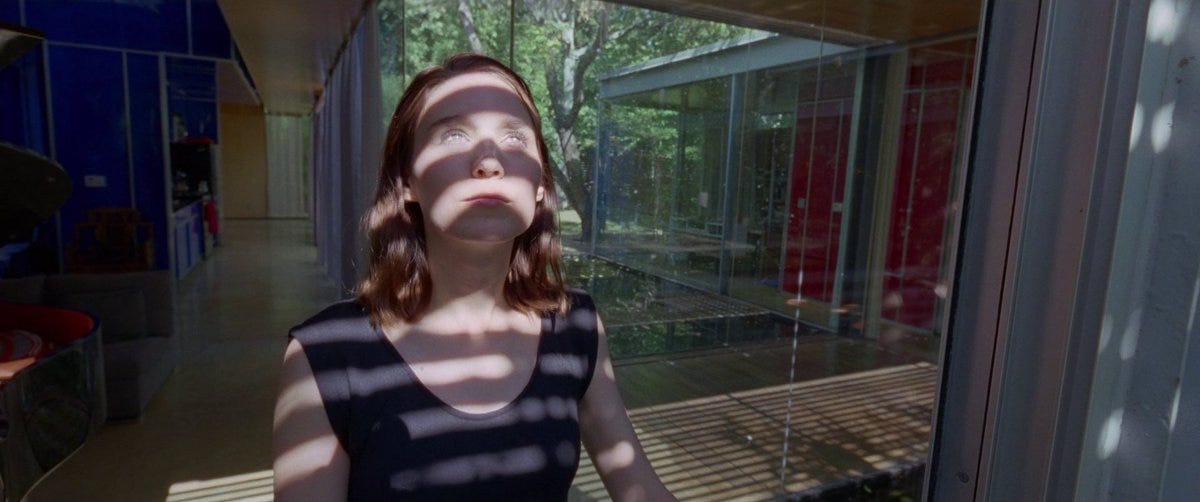
My first exposure to Terrence Malick was rather unconventional. As a college freshman perusing my library’s DVD stacks, I still remember being intrigued by a brightly colored keep case featuring a guitar and one of my favorite actors – Ryan Gosling – on the cover. As soon as I put it into my portable player, I was immediately floored. I had never been to Texas before, but it looked breathtaking.
This was Song to Song, and it was my unconventional path to discovering one of my favorite directors.
Set in Austin, Song to Song is a time capsule of the contemporary music scene, both “do-it-yourself” indie musicians and polished record companies. Struggling independent songwriter Faye (Rooney Mara) is looking for her big break, and after meeting record producer Cook (Michael Fassbender), she hooks up with him under the illusion of stardom.
At the same time, she meets singer-songwriter B.V. (Gosling), one of Cook’s clients who becomes a genuine friend of hers. The central drama comes from this love triangle: while Faye and B.V. grow closer in pure romance, Cook keeps dangling the prize of fame and pushing her more in a secret relationship she clearly does not want. Things go from bad to worse as Cook hooks up with Rhonda (Natalie Portman), a waitress desperate for money, and Faye realizes that Cook was just using her. As Cook love-bombs Rhonda with illusions of true love, she begins to feel uncomfortable with his hard-partying lifestyle, and B.V. and Faye eventually reconnect and live simpler lives.
Malick’s command of parallel narratives help capture the spectrum of modern relationships. B.V. and Faye chase a high-energy romance typical of contemporary “young love” narrative, but Faye’s initial infidelity burns her out as she fails to see B.V.’s authenticity and honest commitment. Cook, by contrast, treats love and people as business deals he needs to “win,” projecting his lust and flaws onto others through coercive control. Rhonda’s grounded devotion is different from any other character in the film, and becomes the easiest character to root for when escaping Cook’s vicious cycle.
Unconventional yet rather masterful, this main love triangle illustrates the dizzying cycle of working in the music industry, or any field of cultural production. The Austin music scene forms a backdrop for the film that is as chaotic as the relationships it centers. B.V. feels like an outsider among the excess and power dynamics of the industry, as his musical style contrasts with the scene’s vision. Faye’s career anxiety swallows her whole as she falls into an abusive relationship. Cook doesn’t create music but considers himself a “visionary” who treats both talented musicians and romantic partners as assets to own and manipulate.
Every character’s search for a big break fuels their emotional instability, and the loud concerts and crowded greenrooms make it difficult for any intimate moments. Personal connections are warped by “grind culture” and shallow networking, and every single person brought into the scene becomes progressively lonelier. It is only by leaving this bohemian lifestyle that true freedom and happiness are found by BV and Faye, as their reconnection comes from both partners understanding and showing their true selves.
Roger Ebert writes that Malick’s films have a unifying theme: “Human lives diminish beneath the overarching majesty of the world.”
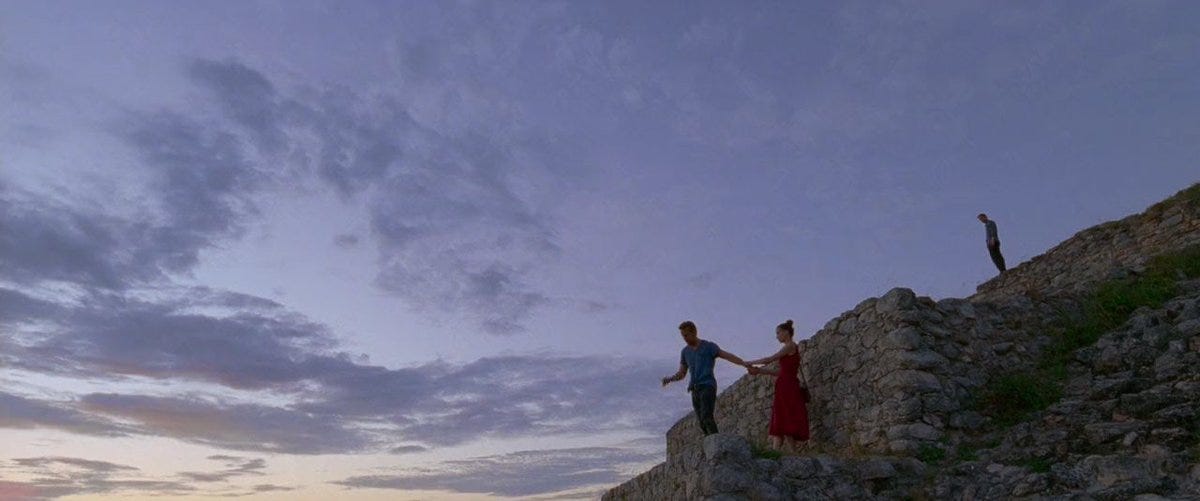
Song to Song’s sun-drenched Texas landscape is open and free, contrary to the trapped, shallow nature of the music industry that Malick is portraying. This “majesty,” however, also comes from the narrative’s explicit ties to Texas, evoking the literary technique of local color. The importance of genuine art and genuine relationships are deep concepts, but when intertwined with Austin bars, venues, and landmarks, the deep narrative stays grounded in reality.
Emmanuel Lubezki’s cinematography helps expand this “majesty” as well. Fresh off the high of two Oscar wins when he shot this, Lubezki’s camera work physically forces the audience into the disorientation that characters feel throughout the film. His close-up shots go right into actors’ faces, distorting the frame and making the whole world around them feel natural and unstable. But in the rare instances of a character being alone, the wide-angle shots make the city of Austin much larger, allowing a short period of meditation among the chaos. Viewers are reminded of the big picture as the scene slows down, as musicians being dwarfed shows how big the scene, and the world, is compared to their individual desires. They are isolated among the industry’s massive engines, and their loneliness in a big world becomes their solace.
But the most impressive use of Lubezki’s skills comes in how he embraces a hallmark of Malick’s work: natural lighting. Texas’s iconic “golden hours,” that brief scenic window where the sun hits at the right time, creates a soft and warm atmosphere that enhances the romantic or nostalgic scenes. The more intense moments have a sliver of light fading and leaving characters in the dark, creating a sense of fleeting beauty. Lubezki uses natural light as a countdown, where actors briefly chase it before it disappears – right as their characters’ temporary fame and superficial relationships crumble.
Malick’s deep personal ties to Austin are amplified with Lubezki’s mastery of lighting techniques, especially in an age where blockbusters are saturated with complicated visual effects. There’s no artificial overlighting here, and the naturally vibrant cities and landscapes anchor the film’s emotional core. Alongside the music scene chaos and local color, Lubezki’s natural light frames Song to Song as a “Texas story” that truly cannot be set anywhere else.
While critics may call Song to Song’s nonlinear storytelling and love triangles “shallow,” the film stands out among Malick’s modern work because of its reminder that good art comes from being your full self. A city with a vibrant music scene is the perfect place to explore spiritual redemption, as hedonism leaves characters feeling unfulfilled. B.V. and Faye face sufferings together at the hand of Cook, whose pride, greed, and corrupting influence call to mind the Devil. But rather than physical pain, their suffering is emotional – associated with broken trust, shallow desires, and empty pleasures, before finding a path towards becoming authentic artists and authentic people. The conclusion is a reconciliation, as Faye’s vulnerability and forgiveness offers her soul the healing it deserved.
B.V. and Faye’s exploitation becomes a catalyst for a simple truth: that making beautiful art, art that nourishes the soul, is a pathway to a better life. The music industry’s superficiality and exploitation, in the name of secular gods like “fame,” caused them to forget why they became artists. Remembering that art is a tool for beauty led them back to a righteous path, even if they were broken coming into it.
While it is a later and more experimental entry, Song to Song might be a perfect introduction to Terrence Malick for fans of contemporary cinema. Characters, plot points, and scenes fade away like they’re songs on an album, and the distinctly modern setting balances a timeless philosophy on creativity. While the central lovers’ actions are frustrating at times, the grand, stunning scenes serve as foreshadowing that everything will be okay once they escape.
Content warning: Song to Song is rated R for sexual scenes and strong language. There’s a lot of value to be found in this film, but some portrayals of sexual themes may be troubling. I recommend using DoesTheDogDie, VidAngel, or your good ol’ fast forward button if it gets uncomfortable.

Oof. All respect to Malick and the team here, but I absolutely hate this one. I fail to see how this one makes the list at all. It's widely regarded as one of Malick's lesser films; one of the projects he spent weekends shooting with his friends and cast members (some of them shot this just while in between projects I believe). It just sort of stumbles along, as the heads of the music industry ruin the lives of all they come into contact with. Characters that crave power and fear intimacy. Suicide, sex addiction with partners of both sexes, shame, the villain's desire to see beauty be twisted for his own perverted pleasure and exercise of power are all depicted here in a way that feels inevitable.
With such a clear depiction of evil, you'd expect there to be an equally clear depiction of good in this film for it to merit entry on this list, and, in my opinion at least, this absolutely does not qualify. The quiet, understated protagonist of BV does not come across as someone who being virtuous, but rather as a protagonist who is caught up in someone else's story. The relationship is a fairly toxic one, and both leads do not seem to have a true idea of what love is by the end of the film.
I like Malick (and thought the inclusion of his other films were well-earned), I love the cast of this film, which is also why I saw it. But I don't see the vision with the positive review for this one or how it makes the list.