


“This great evil, where does it come from?”
In the stacked year of 1998, we were blessed with two of the best WWII films ever made. In July, Spielberg changed the war film genre with Saving Private Ryan, masterfully displaying the brutality of the infamous Omaha Beach and the European theater. While it would be the third most successful film of 1998, another (and arguably better) WWII film would slip in at the end of the year to offer its own distinct and introspective voice: The Thin Red Line. While Malick’s dramatic reentry into the film industry after 20 years was met with somewhat mixed reception and a modest box-office return, I can confidently say it has aged like fine wine, firmly cementing itself as one of the greatest war films ever made.
The Thin Red Line depicts the long and grueling campaign of Guadalcanal. Guadalcanal was one of the more crucial campaigns in the Pacific theater, resulting in significant losses of territory and positions for the Empire of Japan. The more than 6-month conflict was a hard-earned but decisive American victory, further forcing a Japanese retreat after the turning point of Midway. The film is an adaptation of a novel of the same name by James Jones (From Here to Eternity), which depicts 3 different soldiers’ responses to combat and trauma.
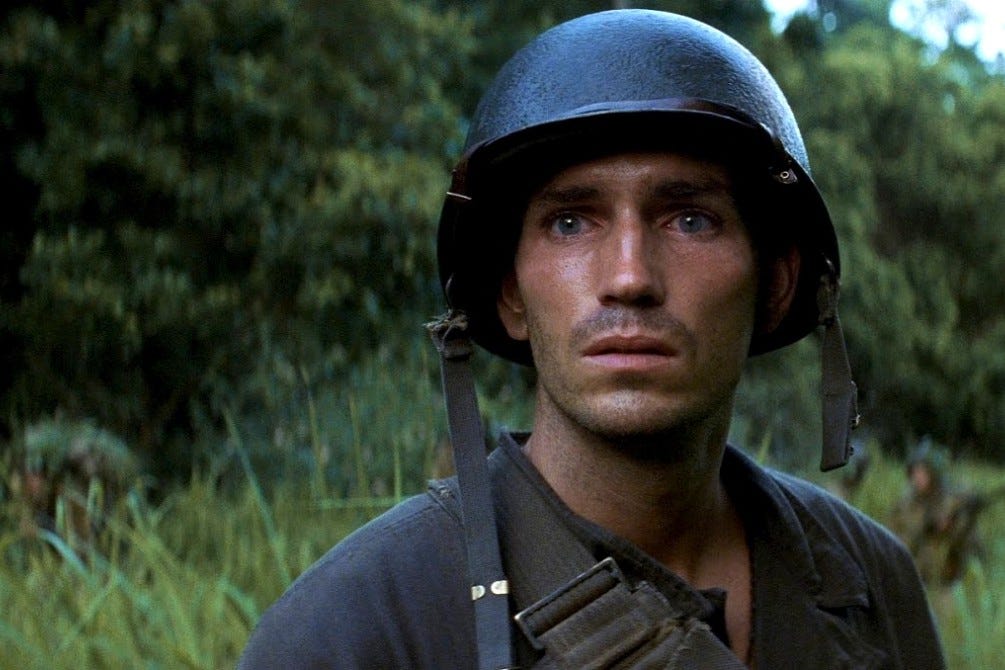
Malick, in an unsurprising manner, takes a rather unconventional approach by having the film less narrative-based and more meditative. The Thin Red Line delves into war, the cost of victory, and the impact we have on the world around us. In this massive star-studded cast, the film seems to primarily focus on the struggles of Sean Penn’s character and Jim Caviezel’s. Gym plays a conscientious objector who flees from combat to live with natives of local Islands, but he’s caught and sent back to the front by Sean Penn. The dynamic between these two sets the tone for most of the film. This main dynamic is the relationship between man and nature. This is not from a merely material stance from the perspective that but a more spiritual understanding of the Earth and the responsibility that man has to keep it, which was given to him in the Garden of Eden. The beauty of the Pacific Islands and the people who inhabit them is consistently juxtaposed with the brutality and carnage of modern warfare. Our characters consistently reflect on this world and the role we play in it, barraging us with an inner monologue that feels distinct to the individual yet applicable to all. Caviezel’s character is perhaps the most sensitive to this, and has a deeply satisfying character arc that shows him discover a more selfless way in expressing his love for humanity.
This is just one of the many characters featured in The Thin Red Line. Part of the joy of watching the film is discovering and watching them interact with each other. The Thin Red Line’s lack of focus on one character is what adds to the grandeur of it. The sheer quantity of A-list actors that practically volunteered for the film upon hearing of Malick’s return was staggering, and left him with the unenviable task of turning down A-listers like Bruce Willis, Brad Pitt, Al Pacino, Gary Oldman, Leonardo DiCaprio, Viggo Mortenson, and Martin Sheen. So many characters are featured in the film; Bill Pullman and Mickey Rourke’s characters didn’t even make the final cut. Despite having to gallop through so many over less than 3 hours, Terrence manages to give each character their own distinct personality and enough time to grow within the world of the Pacific Theater.
I would argue that there is hardly any war film that isn’t “anti-war”. Even the so-called propaganda films of the 1940’s didn’t shy away from the profound sadness of war. As a regular consumer of the genre, I have yet to find one that truly says “Yeah, war is awesome, let’s go!” Thin Red Line takes war to another level, however, and asks its audience to meditate on the true “Why” of war. It elevates the audience to more than just being observers, but instead active participants in the discussion. This creative gesture has always elevated Terrence Malick above most of his contemporaries.
The scale of The Thin Red Line is truly massive. Cinematographer John Toll does a career-defining job with some of the greatest cinematography of the modern Hollywood era. Battles feel grand yet intimate, visceral yet clean, and sweeping yet grounded. I frequently find myself in awe of the spectacle being presented without being distracted from the messaging. There are tracking shots in here that belong in the top 10 of all time, and I am awe-struck to think how they were even pulled off. The beauty of nature is on such display, in perfect sync with one of Hans Zimmer’s more underrated scores, that most of the shots could be used as high-quality wallpapers or paintings.
The Thin Red Line is one of the ultimate cinematic experiences. Through brilliant direction, what could have been a by-the-books soldier memoir is elevated to an extraordinary meditation on man, nature, and God. Beautiful cinematography, excellent acting, impeccable scoring, and high-quality storytelling all come together to make one of the greatest war films ever made.