


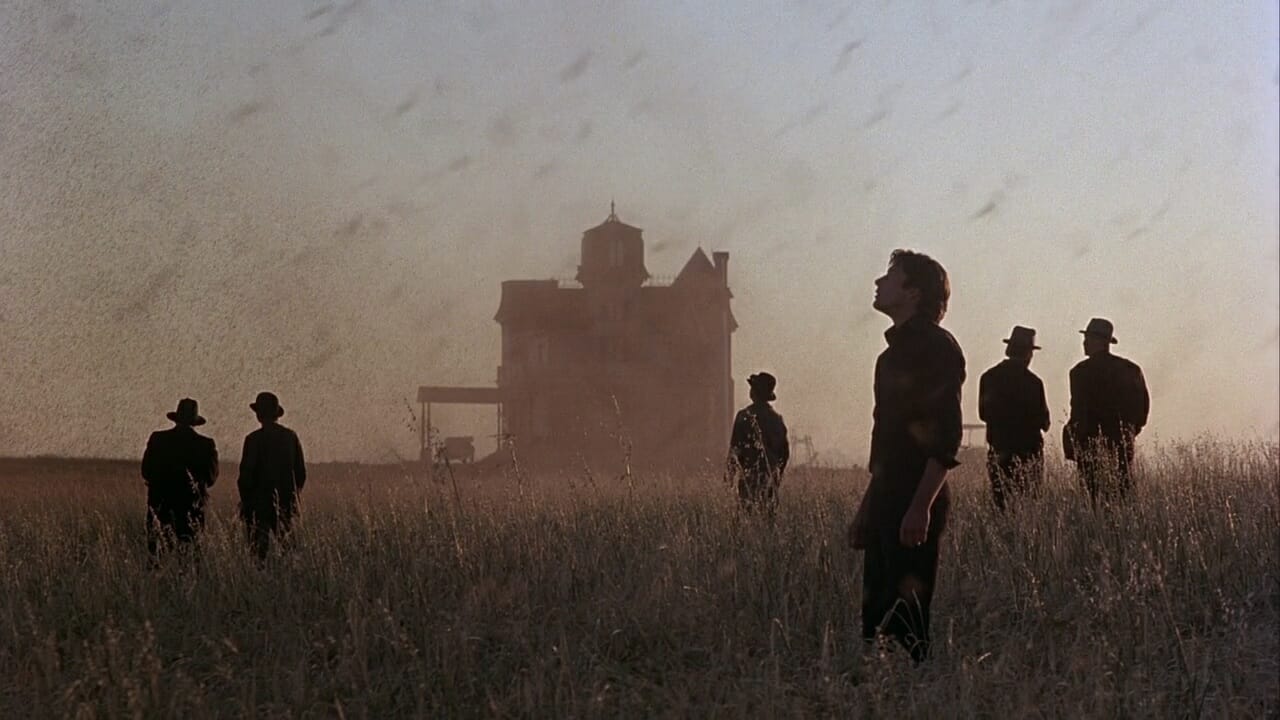
What’s funny about Days of Heaven is that it is in many ways a remake of Malick’s previous film, Badlands.
Both films follow a young couple who flee after the man (in this case, Richard Gere) commits murder. However, unlike Badlands, this is not based on a true story, and the murder was an accident.
Thus begin the comparisons to the Book of Exodus, and the Steinbeckian influence of The Book of Genesis on the next three decades of Malick’s work.
“Whatever Cathy may have been, she set off the glory in Adam. His spirit rose flying and released him from fear and bitterness and rancid memories. The glory lights up the world and changes it the way a star shell changes a battleground.” (East of Eden by John Steinbeck, Chapter 13, Section 2)
“I went to work in the mill. Couldn't wait to get in there. Begin at 7:00. Got to have a smile on your face. And one day you wake up, you find you're not the smartest guy in the world. Never gonna come up with the big score. When I was growin' up, I thought I really would.” - Bill (Richard Gere), Days of Heaven
On January 17, 1917, Emil Avimalg Malick was born in Elizabeth, New Jersey, not far from New York City.
Baptized a Presbyterian, he grew up a strong, capable boy, who excelled at everything he touched, including becoming an accomplished pianist and organist.
Five years prior, Irene Thompson was born to a large Irish Catholic family that lived on farmland not far from Chicago, where she was destined to meet Emil Malick. They married on June 26, 1942, moving to Alexandria, Virginia during a very tumultuous period for the nation.
Prior to the move, Malick had enlisted in the Navy as an officer, before being moved to the Power Plant Division of the Bureau of Aeronautics in Washington D.C. However, he continued his passion for music, helping support his family with recitals featuring a range of music from “the Londonderry Air to J.S. Bach”.1
These were the parents of Terrence Frederick Malick, born on a Tuesday, November 30, 1943 in Ottawa, Illinois: Irene wanted to be home near her family’s farmland for the birth of their first child.
Terrence would eventually come to live the majority of his adolescent life in the suburbs of Waco, Texas, but at heart his roots were planted in the soil of American Midwest farmland.

Malick was sent to boarding school in the fall of 1955, 110 miles away from his family in Waco at St. Stephen’s Episcopal High School, near Austin.
Here lay the roots of Days of Heaven, as quoted in Malick’s last-ever recorded interview given in 1979:
It was in Austin, Texas that I had the idea for ‘Days of Heaven.’ I found myself alone for a summer in the town I had left when I was a high school student. There were those green, undulating hills, and the very beautiful Colorado river. The place is inspired. It is inspiring, and there the film came to me all together. It would be difficult for me to make a film about contemporary America today. We live in such dark times and we have gradually lost our open spaces. We always had hope, the illusion that there was a place where we could live, where one could emigrate and go even further. Wilderness, this is the place where everything seems possible, where solidarity exists—and justice—where the virtues are somehow linked to this justice. In the region where I grew up, everyone felt it in a very strong way. This sense of space disappearing, we nevertheless can find it in cinema, which will pass it on to us There is so much to do: it’s as if we were on the Mississippi Territory, in the eighteenth century. For an hour, or for two days, or longer, these films can enable small changes of heart, changes that mean the same thing: to live better and to love more. And even an old movie in poor and beaten condition and can give us that. What else is there to ask for?
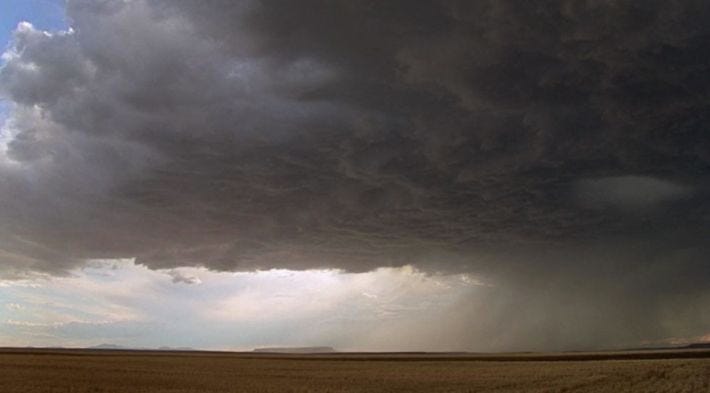
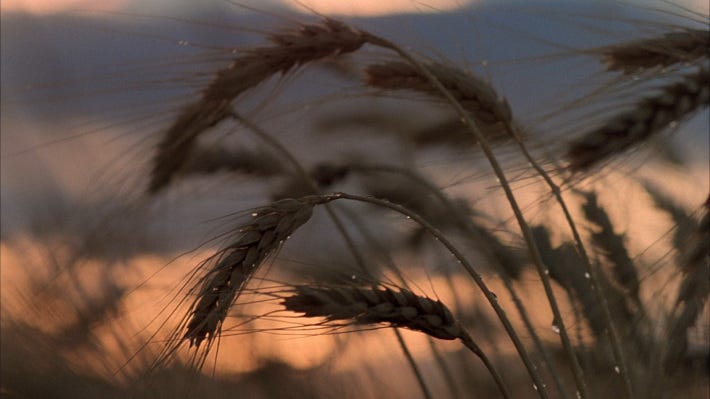
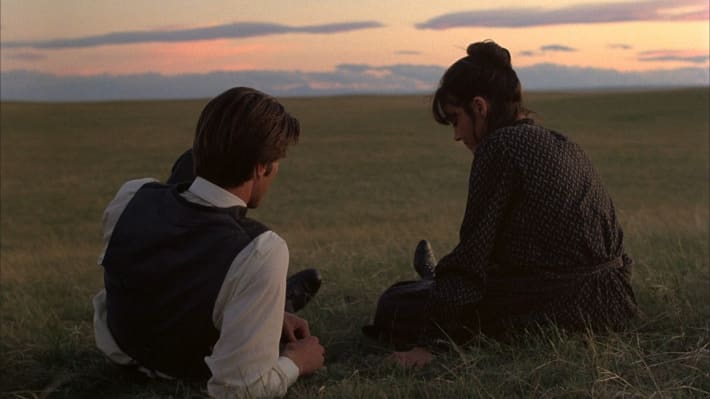
Malick gives what I would call a pretty atypical answer for that younger period of his life. I think, if asked now about his inspiration for Days of Heaven, he would see that it’s a lot more autobiographical than it lets on.
There is a recurring kind of character in Malick’s films, typified first by Martin Sheen’s stoic murderer Kit in Badlands. We’ll call him the Wild Man. In Badlands, Sissy Spacek’s Holly chooses to be with the Wild Man over the Good Man, her father, who sees the evil in Kit and refuses to let his daughter be with him, before Kit kills him.
The Good Man is less of a risk-taker than the Wild Man, and is only drawn out by the appearance of the Woman.
In The Thin Red Line, a whole mix of these two kinds of men are pitted against each other amongst the American Forces in Japan in World War II, with Jim Caviezel’s Pvt. Witt representing the Good Man and Sean Penn’s 1st Sgt. Welsh the Wild. In The New World, Pocahontas must choose between the Colin Farrell’s ex-mercenary John Smith and Christian Bale’s English farmer John Rolfe.
In The Tree of Life, the Woman melds with the Good Man in the form of the protagonist’s mother, Mrs. O’Brien, played by Jessica Chastain, and the Wild Man is characterized by Mr. O’Brien, played by Brad Pitt. Young Jack (Hunter McCracken) must choose whose moral exemplar he must follow. (The name “O’Brien” was chosen for the family after Malick’s maternal Irish grandmother, Katherine “Kitty” O’Brien, a version of whom is actually portrayed in Tree of Life briefly by Fiona Shaw.)
In Days of Heaven, after fleeing from Chicago into the American heartland of the Texas Panhandle (although the film was primarily shot in Alberta, Canada) Bill (Gere), his girlfriend Abby (Brooke Adams), and his younger sister Linda (Linda Manz) must start a new life working on the land of a wealthy farmer (Sam Shepard, whose character is never named).
Bill and Abby keep their relationship a secret, telling the many other workers they encounter that they are brother and sister to avoid any suspicion. The rich Farmer, who is far more shy than the wild Bill, begins to take a liking to Abby; however, he also finds out that he only has one year to live from his doctor from a terminal illness.
One thing leads to another, and soon the newly motivated Farmer, aroused by his short lease on life, asks for Abby’s hand in marriage. Abby, shocked, asks Bill what to do, and he tells her to accept, knowing full well that the Farmer will die within a year and they can inherit his wealth. Abby, though conflicted, accepts.
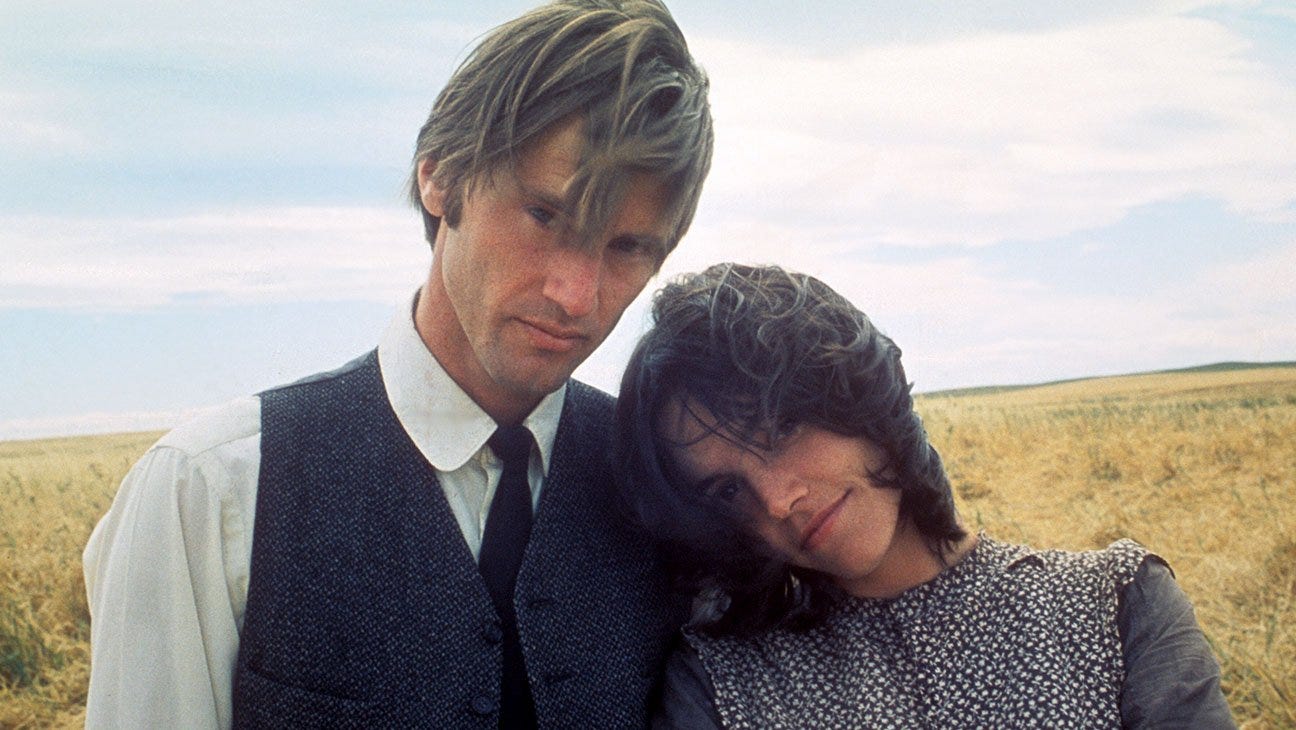
Bill, Abby, Linda, and the Farmer all end up living in a twisted Eden, living an isolated but happy life, until the Farmer begins to pick up that Bill and Abby may not exactly be brother and sister.
Throwing another wrench into the situation, Abby begins to fall deeply in love with her husband despite her continued, secret faithfulness to Bill. And from there, everything begins to crumble.
Bill’s murder back in Chicago of a foreman— a tussle that didn’t mean to get that far— still marked him just as Cain’s murder of Abel did, and the entire movie sees him on the run. He gets a way out- living off the land as a simple farmhand— but eschews it for a sick, twisted will-inheriting scheme that eventually sets him on the run yet again.
But beyond simply being a meditation on Genesis, there’s something more here which I didn’t even realize until I sat down to begin this essay.
The young couple flee from their native Chicago to the Texas Panhandle to begin a new life, essentially raising Linda as their child.
Days of Heaven went through a famously tumultuous production that resulted in Terrence Malick disappearing for twenty years, however that story would take up an entire other essay. What’s important to know from it is that Malick ended up making the decision in post-production— when the cut wasn’t working— to add voice-over from Linda to tie the story together. Large swaths of dialogue (which can be found in the original script) were cut and the movie focused more on visuals.
Linda suddenly became the protagonist— all of the events were viewed through her young, but already slightly jaded eyes, with the voice-over giving us her thoughts on her brother, God, and life itself.
What I didn’t realize until my second rewatch is that Linda is Malick, swept up from a life in Chicago he barely knew to Texas, with his Wild Man father and a mother who wanted more than anything to be seen as Good.
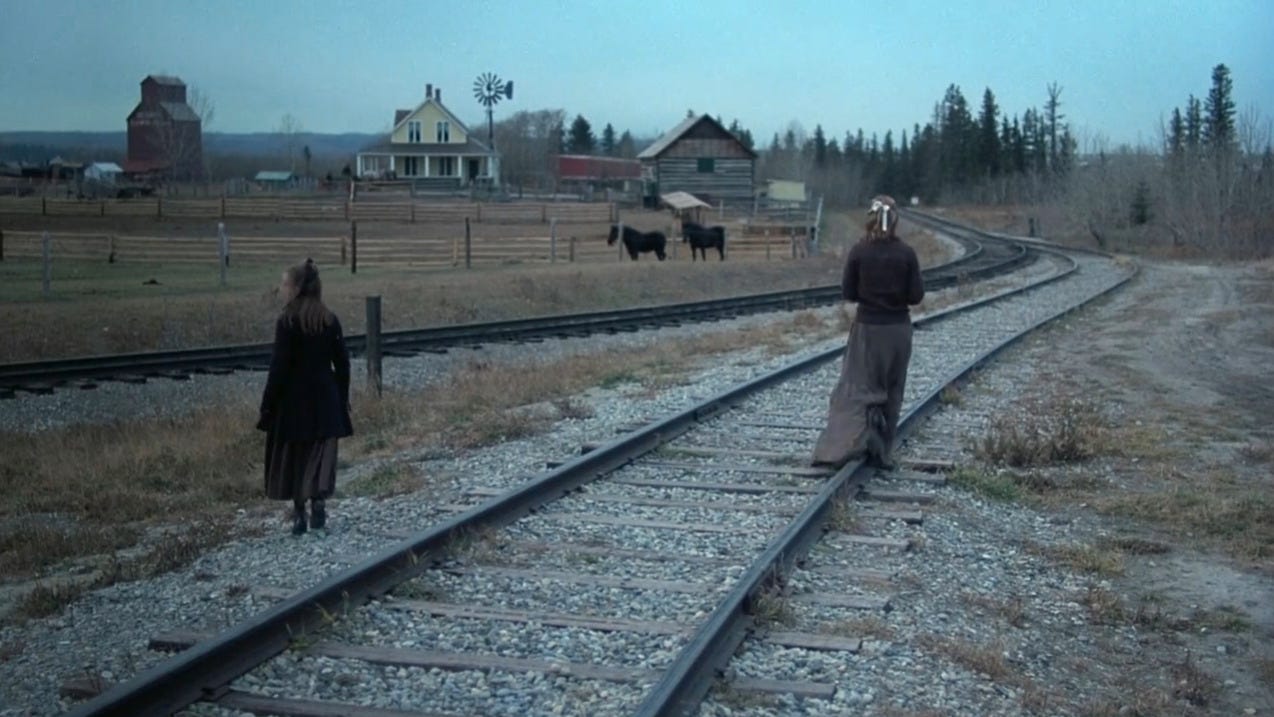
Without spoiling what exactly happens to the characters at the end of the film, the last shot of the movie is Linda following her friend along some train tracks, played by Jackie Shultis, after running away from her Texas boarding school, as we hear Linda muse:
“This girl, she didn't know where she was goin' or what she was gonna do. She didn't have no money on her. Maybe she'd meet up with a character. I was hopin' things would work out for her. She was a good friend of mine.”
100 Movies Every Catholic Should See #2: The Tree of Life (2011)

The Tree of Life is perhaps legendary director Terrence Malick’s most complex and challenging film: initially developed by him back in the 1970s under the mysterious title of Q, the little information we have on the original project indicates it would have explored the “origins of life” with ambitious visuals such as a “
The Magic Hours: The Films and Hidden Life of Terrence Malick, John Bleasdale, (University Press of Kentucky: 2024), page 8.